Ch. 3 - Probability
Larson - Elementary Statistics: Picturing the World 8th Edition
Larson8th EditionElementary Statistics: Picturing the WorldISBN: 9780137493470Not the one you use?Change textbook
Chapter 3, Problem 3.R.5

"In Exercises 5 and 6, use the Fundamental Counting Principle.
5. A student must choose from seven classes to take at 8:00 A.M., four classes to take at 9:00 A.M., and three classes to take at 10:00 A.M. How many ways can the student arrange the schedule?"

Verified step by step guidance
1
Understand the Fundamental Counting Principle: This principle states that if there are multiple events, and each event has a certain number of outcomes, the total number of outcomes is the product of the outcomes for each event.
Identify the events in the problem: The student is choosing one class for each of three time slots: 8:00 A.M., 9:00 A.M., and 10:00 A.M.
Determine the number of choices for each event: The student has 7 choices for the 8:00 A.M. class, 4 choices for the 9:00 A.M. class, and 3 choices for the 10:00 A.M. class.
Apply the Fundamental Counting Principle: Multiply the number of choices for each time slot. This can be expressed as: 7 × 4 × 3.
Interpret the result: The product of these numbers represents the total number of ways the student can arrange their schedule.

Verified video answer for a similar problem:

This video solution was recommended by our tutors as helpful for the problem above.
Video duration:
2m
Was this helpful?

Key Concepts

Here are the essential concepts you must grasp in order to answer the question correctly.

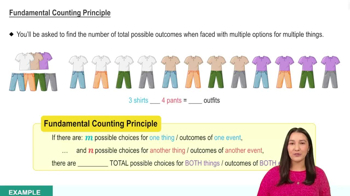
Fundamental Counting Principle

The Fundamental Counting Principle states that if there are 'm' ways to do one thing and 'n' ways to do another, then there are m × n ways to perform both actions. This principle is essential for calculating the total number of combinations or arrangements in scenarios where multiple choices are involved.
Recommended video:
04:04
Fundamental Counting Principle

Combinations

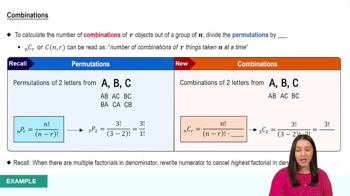
Combinations refer to the selection of items from a larger set where the order does not matter. In the context of the question, the student is choosing classes, and the specific order of selection is irrelevant, making combinations a key concept for determining the number of possible schedules.
Recommended video:
05:22
Combinations

Permutations

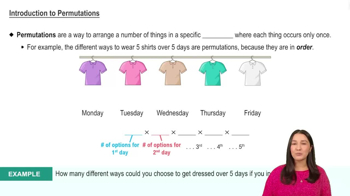
Permutations involve the arrangement of items where the order does matter. While the question primarily focuses on combinations, understanding permutations is important for grasping how different arrangements can affect the total count of possible schedules, especially if the order of classes were to be considered.
Recommended video:
07:11
Introduction to Permutations
Related Practice
Textbook Question

In Exercises 49-53, use counting principles to find the probability.

51. A shipment of 200 calculators contains 3 defective units. What is the probability that a sample of three calculators will have

c. at least one defective calculator?

Textbook Question

In Exercises 45-48, use combinations and permutations.

46. Five players on a basketball team must each choose one of the five players on the opposing team to defend. In how many ways can the players choose their defensive assignments?

Textbook Question

"In Exercises 1-4, identify the sample space of the probability experiment and determine the number of outcomes in the event. Draw a tree diagram when appropriate.

1. Experiment: Tossing four coins

Event: Getting three heads"

Textbook Question

"In Exercises 1-4, identify the sample space of the probability experiment and determine the number of outcomes in the event. Draw a tree diagram when appropriate.

4. Experiment: Guessing the gender(s) of the three children in a family

Event: Guessing that the family has two boys"

1
views
Textbook Question

The table shows the numbers (in thousands) of earned degrees by level in two different fields, conferred in the United States in a recent year. (Source: U.S. National Center for Education Statistics)

A person who earned a degree in the year is randomly selected. Find the probability that the degree earned by the person is a

g. bachelor's degree and the degree is in natural sciences/mathematics.

Textbook Question

In Exercises 49-53, use counting principles to find the probability.

53. A corporation has six male senior executives and four female senior executives. Four senior executives are chosen at random to attend a technology seminar. What is the

probability of choosing

c. two men and two women?