Ch. 3 - Probability
Larson - Elementary Statistics: Picturing the World 8th Edition
Larson8th EditionElementary Statistics: Picturing the WorldISBN: 9780137493470Not the one you use?Change textbook
Chapter 3, Problem 3.RE.20

"In Exercises 19-22, determine whether the events are independent or dependent. Explain your reasoning.
20. Selecting an ace from a standard deck of 52 playing cards, and then selecting a jack from the deck without replacing the ace"

Verified step by step guidance
1
Understand the concept of independence: Two events are independent if the occurrence of one event does not affect the probability of the other event occurring. Conversely, events are dependent if the outcome of one event influences the outcome of the other.
Identify the two events in the problem: Event A is selecting an ace from a standard deck of 52 cards, and Event B is selecting a jack from the deck without replacing the ace.
Analyze the situation: If the ace is not replaced after being selected, the total number of cards in the deck decreases from 52 to 51. This change affects the probability of selecting a jack in the second draw, as there are now fewer cards to choose from.
Determine dependency: Since the probability of selecting a jack (Event B) depends on whether the ace was removed (Event A), the two events are dependent.
Explain the reasoning: The dependency arises because the removal of the ace alters the composition of the deck, thereby influencing the likelihood of drawing a jack in the second draw.

Verified video answer for a similar problem:

This video solution was recommended by our tutors as helpful for the problem above.
Video duration:
2m
Was this helpful?

Key Concepts

Here are the essential concepts you must grasp in order to answer the question correctly.

Independent Events

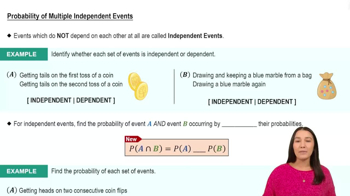
Independent events are those whose outcomes do not affect each other. In probability, two events A and B are independent if the occurrence of A does not change the probability of B occurring. For example, flipping a coin and rolling a die are independent events because the result of one does not influence the other.
Recommended video:
05:54
Probability of Multiple Independent Events

Dependent Events

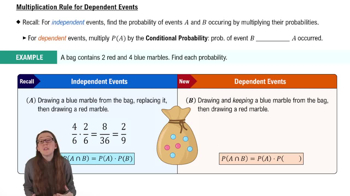
Dependent events are those where the outcome of one event affects the outcome of another. In probability, two events A and B are dependent if the occurrence of A changes the probability of B occurring. For instance, drawing cards from a deck without replacement is a classic example of dependent events, as the first draw alters the composition of the deck for the second draw.
Recommended video:
05:17
Multiplication Rule: Dependent Events

Probability without Replacement

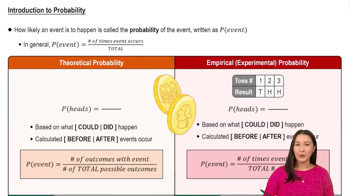
When selecting items without replacement, the total number of items decreases with each selection, which affects the probabilities of subsequent selections. In the context of the question, after selecting an ace from a deck of cards, there are now only 51 cards left, which changes the probability of drawing a jack next. This illustrates how the first event influences the second, indicating dependence.
Recommended video:
5:37
Introduction to Probability
Related Practice
Textbook Question

"In Exercises 19-22, determine whether the events are independent or dependent. Explain your reasoning.

21. Taking a driver's education course and passing the driver's license exam"
Textbook Question

In Exercises 1-4, identify the sample space of the probability experiment and determine the number of outcomes in the event. Draw a tree diagram when appropriate.

3. Experiment: Choosing a month of the year

Event: Choosing a month that begins with the letter J

Textbook Question

In Exercises 33 and 34, use the pie chart at the left, which shows the percent distribution of the number of students in U.S. public schools in a recent year. (Source: U.S. National Center for Education Statistics)

" style="" width="200">

34. Find the probability of randomly selecting a school with 300 or more students.

Textbook Question

28. A sample of 6500 automobiles found that 1560 of the automobiles were black, 3120 of the automobiles were sedans, and 1170 of the automobiles were black sedans. Find the probability that a randomly chosen automobile from this sample is black or a sedan.

1
views
Textbook Question

In Exercises 5 and 6, use the Fundamental Counting Principle.

6. The state of Virginia's license plates have three letters and four digits. Assuming that any letter or digit can be used, how many different license plates are possible?

Textbook Question

In Exercises 13 and 14, use the table, which shows the approximate distribution of the sizes of firms for a recent year. (Adapted from North American Industry Classification System)

" style="" width="521">

13. Find the probability that a randomly selected firm will have more than four employees.