Ch. 3 - Probability
Larson - Elementary Statistics: Picturing the World 8th Edition
Larson8th EditionElementary Statistics: Picturing the WorldISBN: 9780137493470Not the one you use?Change textbook
Chapter 3, Problem 3.3.23c

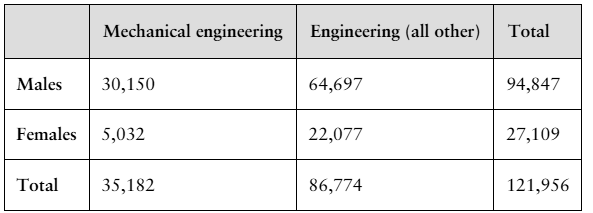
23. Engineering Degrees The table shows the numbers of male and female students in the U.S. who received B.S. degrees in engineering in a recent year. A student earning a B.S. degree in engineering during that year is selected at random. Find the probability of each event.
(Source: National Center for Educational Statistics)
Table displaying the number of male and female students earning engineering degrees, including totals for mechanical engineering.
c. The student is not female or did not receive a mechanical engineering degree.

Verified step by step guidance
1
Step 1: Understand the problem. We are tasked with finding the probability that a randomly selected student is not female or did not receive a mechanical engineering degree. This involves using the complement rule and the addition rule in probability.
Step 2: Identify the total number of students. From the table, the total number of students who received B.S. degrees in engineering is 121,956.
Step 3: Calculate the number of students who are female and received a mechanical engineering degree. From the table, the number of females who received mechanical engineering degrees is 5,032.
Step 4: Use the complement rule to find the number of students who are not female or did not receive a mechanical engineering degree. This is equivalent to subtracting the number of students who are female and received a mechanical engineering degree from the total number of students.
Step 5: Divide the result from Step 4 by the total number of students (121,956) to find the probability. This gives the probability that a randomly selected student is not female or did not receive a mechanical engineering degree.

Verified video answer for a similar problem:

This video solution was recommended by our tutors as helpful for the problem above.
Video duration:
4m
Was this helpful?

Key Concepts

Here are the essential concepts you must grasp in order to answer the question correctly.

Probability

Probability is a measure of the likelihood that an event will occur, expressed as a number between 0 and 1. In this context, it involves calculating the chance of selecting a student who is either not female or did not receive a mechanical engineering degree. This requires understanding how to combine probabilities of different events.
Recommended video:
5:37
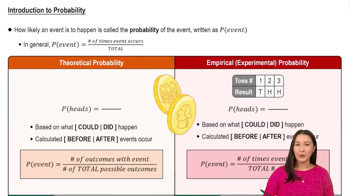
Introduction to Probability

Complementary Events

Complementary events are pairs of outcomes in a probability scenario where one event occurs if and only if the other does not. In this case, the event of selecting a student who is not female or did not receive a mechanical engineering degree can be analyzed by considering the complementary event: selecting a female student who received a mechanical engineering degree.
Recommended video:
4:23
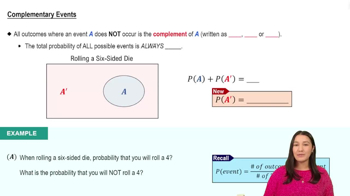
Complementary Events

Joint Probability

Joint probability refers to the probability of two events occurring simultaneously. To solve the question, one must calculate the joint probability of selecting a female student who received a mechanical engineering degree and then use this to find the probability of the complementary event. This involves using the data from the table to determine the relevant counts.
Recommended video:
5:37
Introduction to Probability
Related Practice
Textbook Question

2. Determine whether each number could represent the probability of an event. Explain your reasoning. c. 2.3
Textbook Question

"Using the Multiplication Rule In Exercises 19-32, use the Multiplication Rule.

25. Best President In a sample of 1500 adult U.S. citizens, 270 said that Barack Obama was the best president in U.S. history. Two adult U.S. citizens are selected at random.

(Adapted from YouGov)

c. Find the probability that at least one of the two adult U.S. citizens says that Barack Obama was the best president in U.S. history."

Textbook Question

"Using the Multiplication Rule In Exercises 19-32, use the Multiplication Rule.

24. Knowing a Person Who Was Murdered In a sample of 11,771 children ages 2 to 17, 8% have lost a friend or relative to murder. Four children are selected at random. (Adapted from University of New Hampshire)

c. Find the probability that at least one of the four has lost a friend or relative to murder."

Textbook Question

"Using the Multiplication Rule In Exercises 19-32, use the Multiplication Rule.

23. Celebrities as Role Models In a sample of 1103 probable voters, three out of four say they would like entertainers to address social and political issues. Two probable voters are selected at random. (Source: The Hollywood Reporter)

c. Find the probability that at least one of the two probable voters would like entertainers to address social and political issues."

Textbook Question

19. U.S. Age Distribution The projected percent distribution of the U.S. population for 2025 is shown in the pie chart. Find the probability of each event. (Source: U.S. Census

Bureau)

c. Randomly selecting someone who is not 60 years or over

Textbook Question

17. Selecting a Card A card is selected at random from a standard deck of 52 playing cards. Find the probability of each event.

c. Randomly selecting a 9 or a face card