
Textbook Question
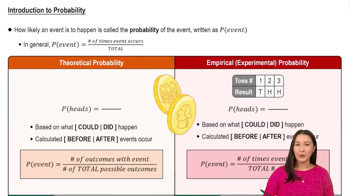
2. Determine whether each number could represent the probability of an event. Explain your reasoning. c. 2.3
 Verified step by step guidance
 5:37
5:37
 06:00
06:00 04:04
04:042. Determine whether each number could represent the probability of an event. Explain your reasoning. c. 2.3
"Using the Multiplication Rule In Exercises 19-32, use the Multiplication Rule.
25. Best President In a sample of 1500 adult U.S. citizens, 270 said that Barack Obama was the best president in U.S. history. Two adult U.S. citizens are selected at random.
(Adapted from YouGov)
c. Find the probability that at least one of the two adult U.S. citizens says that Barack Obama was the best president in U.S. history."
"Using the Multiplication Rule In Exercises 19-32, use the Multiplication Rule.
24. Knowing a Person Who Was Murdered In a sample of 11,771 children ages 2 to 17, 8% have lost a friend or relative to murder. Four children are selected at random. (Adapted from University of New Hampshire)
c. Find the probability that at least one of the four has lost a friend or relative to murder."
"Using the Multiplication Rule In Exercises 19-32, use the Multiplication Rule.
23. Celebrities as Role Models In a sample of 1103 probable voters, three out of four say they would like entertainers to address social and political issues. Two probable voters are selected at random. (Source: The Hollywood Reporter)
c. Find the probability that at least one of the two probable voters would like entertainers to address social and political issues."
19. U.S. Age Distribution The projected percent distribution of the U.S. population for 2025 is shown in the pie chart. Find the probability of each event. (Source: U.S. Census
Bureau)
c. Randomly selecting someone who is not 60 years or over
23. Engineering Degrees The table shows the numbers of male and female students in the U.S. who received B.S. degrees in engineering in a recent year. A student earning a B.S. degree in engineering during that year is selected at random. Find the probability of each event.
(Source: National Center for Educational Statistics)
c. The student is not female or did not receive a mechanical engineering degree.