Ch. 2 - Descriptive Statistics
Larson - Elementary Statistics: Picturing the World 8th Edition
Larson8th EditionElementary Statistics: Picturing the WorldISBN: 9780137493470Not the one you use?Change textbook
Chapter 2, Problem 2.1.45a

What Would You Do? You work at a bank and are asked to recommend the amount of cash to put in an ATM each day. You do not want to put in too much (which would cause security concerns) or too little (which may create customer irritation). The daily withdrawals (in hundreds of dollars) for 30 days are listed. 72 84 61 76 104 76 86 92 80 88 98 76 97 82 84 67 70 81 82 89 74 73 86 81 85 78 82 80 91 83
Construct a relative frequency histogram for the data. Use 8 classes.

Verified step by step guidance
1
Step 1: Organize the data. Start by identifying the range of the data. The range is calculated as the difference between the maximum value (104) and the minimum value (61). This will help determine the class width.
Step 2: Determine the class width. Divide the range by the number of classes (8) and round up to the nearest whole number. The formula for class width is: RangeNumber of Classes. Add 1 if necessary to ensure all data points are included.
Step 3: Create the class intervals. Start with the minimum value (61) and add the class width to create the next interval. Repeat this process until you have 8 intervals. Ensure that the intervals do not overlap and cover the entire range of the data.
Step 4: Count the frequency of data points in each class interval. For each interval, count how many data points fall within that range. This will give you the frequency for each class.
Step 5: Calculate the relative frequency for each class. Divide the frequency of each class by the total number of data points (30). The formula is: Frequency of ClassTotal Frequency. Use these relative frequencies to construct the histogram, with the class intervals on the x-axis and the relative frequencies on the y-axis.

Verified video answer for a similar problem:

This video solution was recommended by our tutors as helpful for the problem above.
Video duration:
2m
Was this helpful?

Key Concepts

Here are the essential concepts you must grasp in order to answer the question correctly.

Relative Frequency

Relative frequency is the ratio of the number of times a particular value or range of values occurs in a dataset to the total number of observations. It provides a way to understand the proportion of each class in relation to the whole dataset, making it easier to compare different classes. In the context of the ATM withdrawals, calculating relative frequencies will help determine how often certain withdrawal amounts occur, which is crucial for making informed decisions about cash management.
Recommended video:
Guided course
06:38
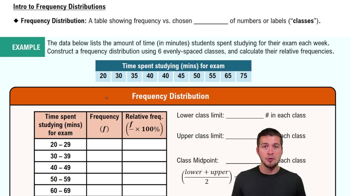
Intro to Frequency Distributions

Histogram

A histogram is a graphical representation of the distribution of numerical data, where the data is divided into intervals or 'bins.' Each bin represents a range of values, and the height of the bar indicates the frequency of data points within that range. In this case, constructing a histogram with 8 classes will visually display the distribution of daily ATM withdrawals, allowing for quick insights into patterns and trends in customer behavior.
Recommended video:
Guided course
05:54
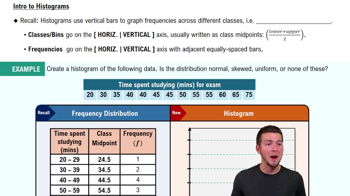
Intro to Histograms

Class Intervals

Class intervals are the specific ranges into which data is grouped for analysis, particularly in histograms. Choosing appropriate class intervals is essential for accurately representing the data's distribution; too few classes may oversimplify the data, while too many can obscure trends. For the ATM withdrawal data, defining 8 suitable class intervals will help in effectively summarizing the withdrawal amounts and facilitating better decision-making regarding cash replenishment.
Recommended video:
Guided course
09:00
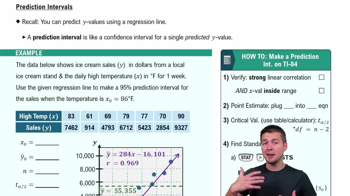
Prediction Intervals