
Textbook Question
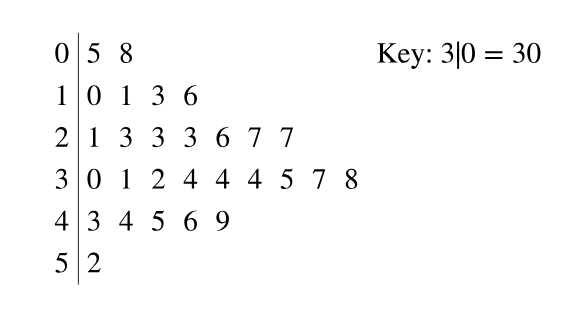
Constructing Data Sets In Exercises 5– 8, construct the described data set. The entries in the data set cannot all be the same.
Mean and median are the same and the data is bimodal.
1
views
 Verified step by step guidance
 04:52
04:52
 03:26
03:26 07:10
07:10Constructing Data Sets In Exercises 5– 8, construct the described data set. The entries in the data set cannot all be the same.
Mean and median are the same and the data is bimodal.
Construct a frequency distribution for the data set using the indicated number of classes. In the table, include the midpoints, relative frequencies, and cumulative frequencies. Which class has the greatest class frequency and which has the least class frequency.
Textbook Spending
Number of classes: 6
Data set: Amounts (in dollars) spent on textbooks for a semester 91 472 279 249 530 376 188 341 266 199 142 273 189 130 489 266 248 101 375 486 190 398 188 269 43 30 127 354 84 319
Finding a Weighted Mean In Exercises 41– 46, find the weighted mean of the data.
Final Grade The scores and their percents of the final grade for a statistics student are shown below. What is the student’s mean score?
Interpreting Percentiles In Exercises 29–32, use the ogive, which represents the cumulative frequency distribution for quantitative reasoning scores on the Graduate Record Examination in a recent range of years. (Adapted from Educational Testing Service)
What score represents the 65th percentile? How should you interpret this?
Determine whether the statement is true or false. If it is false, rewrite it as a true statement.
Class boundaries ensure that consecutive bars of a histogram touch.
Interpreting Percentiles In Exercises 29–32, use the ogive, which represents the cumulative frequency distribution for quantitative reasoning scores on the Graduate Record Examination in a recent range of years. (Adapted from Educational Testing Service)
What percentile is a score of 170? How should you interpret this?