Ch. 2 - Descriptive Statistics
Larson - Elementary Statistics: Picturing the World 8th Edition
Larson8th EditionElementary Statistics: Picturing the WorldISBN: 9780137493470Not the one you use?Change textbook
Chapter 2, Problem 2.R.46

The towing capacities (in pounds) of all the pickup trucks at a dealership have a bell-shaped distribution, with a mean of 11,830 pounds and a standard deviation of 2370 pounds. In Exercises 45– 48, use the corresponding z-score to determine whether the towing capacity is unusual. Explain your reasoning.


5,500 pounds

Verified step by step guidance
1
Step 1: Understand the problem. The towing capacities follow a bell-shaped distribution, which indicates a normal distribution. The mean (μ) is 11,830 pounds, and the standard deviation (σ) is 2,370 pounds. We are tasked with determining if a towing capacity of 5,500 pounds is unusual using the z-score formula.
Step 2: Recall the z-score formula: z=x-μσ, where x is the data point, μ is the mean, and σ is the standard deviation. The z-score measures how many standard deviations a data point is from the mean.
Step 3: Substitute the given values into the formula. Here, x = 5,500, μ = 11,830, and σ = 2,370. The z-score calculation will look like this: z=5500-118302370.
Step 4: Interpret the z-score. A z-score less than -2 or greater than 2 is typically considered unusual in a normal distribution. This is because approximately 95% of the data falls within 2 standard deviations of the mean, leaving only 5% of the data in the tails.
Step 5: After calculating the z-score, compare its value to the threshold of -2 or 2. If the z-score is outside this range, the towing capacity of 5,500 pounds is considered unusual. If it is within this range, it is not unusual.

Verified video answer for a similar problem:

This video solution was recommended by our tutors as helpful for the problem above.
Video duration:
1m
Was this helpful?

Key Concepts

Here are the essential concepts you must grasp in order to answer the question correctly.

Normal Distribution

A normal distribution is a bell-shaped probability distribution characterized by its mean and standard deviation. In this context, the towing capacities of pickup trucks follow a normal distribution, meaning most values cluster around the mean (11,830 pounds) and taper off symmetrically towards the extremes. Understanding this concept is crucial for determining how unusual a specific towing capacity is relative to the overall distribution.
Recommended video:
06:23
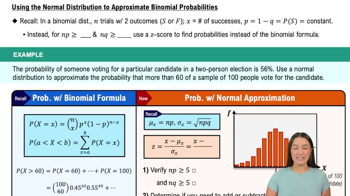
Using the Normal Distribution to Approximate Binomial Probabilities

Z-Score

The z-score is a statistical measure that indicates how many standard deviations an element is from the mean of a distribution. It is calculated by subtracting the mean from the value in question and then dividing by the standard deviation. In this case, calculating the z-score for a towing capacity of 5,500 pounds will help assess whether this value is considered unusual within the context of the truck towing capacities.
Recommended video:
Guided course
06:31
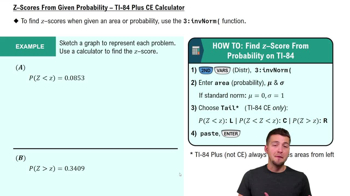
Z-Scores From Given Probability - TI-84 (CE) Calculator

Unusual Values

In statistics, a value is often considered unusual if it lies more than two standard deviations away from the mean in a normal distribution. This threshold helps identify outliers or extreme values that may not fit the general pattern of the data. By determining the z-score for the towing capacity of 5,500 pounds, we can evaluate whether it falls within this unusual range, thus informing our reasoning about its significance.
Recommended video:
Guided course
06:50
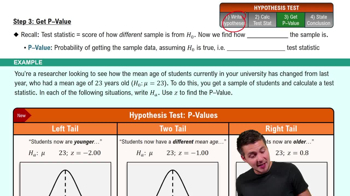
Step 3: Get P-Value
Related Practice
Textbook Question

A student’s test grade of 75 represents the 65th percentile of the grades. What percent of students scored higher than 75?
Textbook Question

In Exercises 17–19, use the data set, which represents the points recorded by each player on the Winnipeg Jets in the 2019–2020 NHL season. (Source: National Hockey League)

8 8 8 6 0 73 26 1

0 5 58 1 7 5 10 63

0 5 10 0 31 5 15 45

16 29 10 73 5 3 0 65


Construct a frequency distribution for the data set using eight classes. Include class limits, midpoints, boundaries, frequencies, relative frequencies, and cumulative frequencies.

2
views
Textbook Question

In Exercises 7 and 8, use the data set shown in the table at the left, which represents the pollution indices (a unitless measure of pollution ranging from 0 to 100) for 24 U.S. cities. (Adapted from Numbeo)

Use a dot plot to display the data set. Describe any patterns.

1
views
Textbook Question

In Exercises 21 and 22, determine whether the approximate shape of the distribution in the histogram is symmetric, uniform, skewed left, skewed right, or none of these.

Textbook Question

In Exercises 27 and 28, find the range, mean, variance, and standard deviation of the sample data set.


Salaries (in dollars) of a random sample of teachers

62,222 56,719 50,259 45,120 47,692 45,985 53,489 71,534

Textbook Question

In Exercises 25 and 26, find the range, mean, variance, and standard deviation of the population data set.


The mileages (in thousands of miles) for a rental car company’s fleet.

4 2 9 12 15 3 6 8 1 4 14 12 3 3