Ch. 2 - Descriptive Statistics
Larson - Elementary Statistics: Picturing the World 8th Edition
Larson8th EditionElementary Statistics: Picturing the WorldISBN: 9780137493470Not the one you use?Change textbook
Chapter 2, Problem 2.R.8

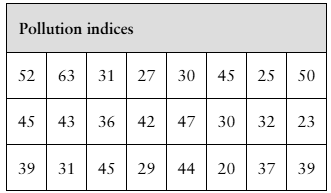
In Exercises 7 and 8, use the data set shown in the table at the left, which represents the pollution indices (a unitless measure of pollution ranging from 0 to 100) for 24 U.S. cities. (Adapted from Numbeo)

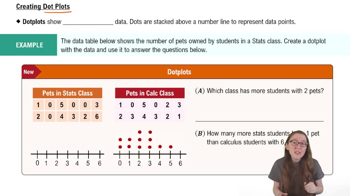
Use a dot plot to display the data set. Describe any patterns.

Verified step by step guidance
1
Step 1: Understand the data set. The table contains pollution indices for 24 U.S. cities, ranging from 0 to 100. Each value represents a unitless measure of pollution.
Step 2: Organize the data. Extract all the pollution indices from the table and list them in ascending order to make it easier to plot the dot plot. For example: [20, 23, 23, 25, 27, 29, 30, 30, 31, 31, 32, 36, 37, 39, 39, 42, 43, 44, 45, 45, 45, 47, 50, 52, 63].
Step 3: Create a dot plot. On a horizontal axis, label the range of pollution indices (e.g., 20 to 63). For each pollution index value, place a dot above the corresponding number on the axis. If a value appears multiple times, stack the dots vertically.
Step 4: Analyze the dot plot. Look for patterns such as clustering of values, gaps, or outliers. For example, you might notice that most pollution indices are clustered between 30 and 50, with fewer cities having indices below 30 or above 50.
Step 5: Describe the patterns. Based on the dot plot, summarize the distribution of pollution indices. For instance, you might note that the data is moderately spread out, with a concentration of values in the mid-range (30-50), and a few cities with lower or higher pollution indices.

Verified video answer for a similar problem:

This video solution was recommended by our tutors as helpful for the problem above.
Video duration:
5m
Was this helpful?

Key Concepts

Here are the essential concepts you must grasp in order to answer the question correctly.

Dot Plot

A dot plot is a simple graphical display used to represent the frequency of data points in a dataset. Each value is represented by a dot above a number line, allowing for easy visualization of the distribution and frequency of the data. It is particularly useful for small to moderate-sized datasets, as it clearly shows clusters, gaps, and outliers.
Recommended video:
04:01
Creating Dotplots

Descriptive Statistics

Descriptive statistics summarize and describe the main features of a dataset. This includes measures such as mean, median, mode, range, and standard deviation, which provide insights into the central tendency and variability of the data. Understanding these statistics is essential for interpreting the patterns observed in the dot plot.
Recommended video:
Guided course
05:53
Parameters vs. Statistics

Patterns in Data

Identifying patterns in data involves looking for trends, clusters, or anomalies within the dataset. In the context of pollution indices, one might observe whether pollution levels are generally high or low, if there are any outliers, or if certain ranges of pollution indices are more common. Recognizing these patterns helps in understanding the overall environmental conditions represented by the data.
Recommended video:
4:01
Introduction to Collecting Data
Related Practice
Textbook Question

A student’s test grade of 75 represents the 65th percentile of the grades. What percent of students scored higher than 75?
Textbook Question

In Exercises 17–19, use the data set, which represents the points recorded by each player on the Winnipeg Jets in the 2019–2020 NHL season. (Source: National Hockey League)

8 8 8 6 0 73 26 1

0 5 58 1 7 5 10 63

0 5 10 0 31 5 15 45

16 29 10 73 5 3 0 65


Construct a frequency distribution for the data set using eight classes. Include class limits, midpoints, boundaries, frequencies, relative frequencies, and cumulative frequencies.

2
views
Textbook Question

In Exercises 37– 40, use the data set, which represents the model 2020 vehicles with the highest fuel economies (in miles per gallon) in the most popular classes. (Source: U.S. Environmental Protection Agency)

36 30 30 45 31 113 113 33 33 33 52 141 56 117 58

118 50 26 23 23 27 48 22 22 22 121 41 105 35 35


Find the five-number summary of the data set.

Textbook Question

The towing capacities (in pounds) of all the pickup trucks at a dealership have a bell-shaped distribution, with a mean of 11,830 pounds and a standard deviation of 2370 pounds. In Exercises 45– 48, use the corresponding z-score to determine whether the towing capacity is unusual. Explain your reasoning.


5,500 pounds

Textbook Question

In Exercises 21 and 22, determine whether the approximate shape of the distribution in the histogram is symmetric, uniform, skewed left, skewed right, or none of these.

Textbook Question

In Exercises 25 and 26, find the range, mean, variance, and standard deviation of the population data set.


The mileages (in thousands of miles) for a rental car company’s fleet.

4 2 9 12 15 3 6 8 1 4 14 12 3 3