Ch. 1 - Introduction to Statistics
Larson - Elementary Statistics: Picturing the World 8th Edition
Larson8th EditionElementary Statistics: Picturing the WorldISBN: 9780137493470Not the one you use?Change textbook
Chapter 1, Problem 1.1.2

Why is a sample used more often than a population?

Verified step by step guidance
1
A population refers to the entire group of individuals or items that we are interested in studying, while a sample is a smaller subset of the population chosen for analysis. Studying the entire population is often impractical due to constraints such as time, cost, and accessibility.
Sampling allows researchers to gather data more efficiently and quickly, as it requires fewer resources compared to studying the entire population. This makes it a practical approach for most statistical studies.
When a sample is chosen carefully using appropriate sampling methods (e.g., random sampling), it can provide a representative snapshot of the population, allowing researchers to make valid inferences about the population as a whole.
Statistical techniques, such as confidence intervals and hypothesis testing, are designed to account for the uncertainty introduced by sampling. These methods help ensure that conclusions drawn from the sample are reliable and generalizable to the population.
Using a sample also reduces the complexity of data analysis, as working with a smaller dataset is computationally simpler and more manageable than analyzing data from an entire population.

Verified video answer for a similar problem:

This video solution was recommended by our tutors as helpful for the problem above.
Video duration:
4m
Was this helpful?

Key Concepts

Here are the essential concepts you must grasp in order to answer the question correctly.

Sampling

Sampling is the process of selecting a subset of individuals from a larger population to estimate characteristics of the whole group. It is often used in statistics to make inferences about a population without needing to collect data from every member, which can be impractical or impossible.
Recommended video:
05:11
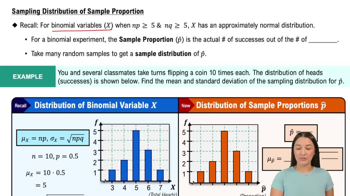
Sampling Distribution of Sample Proportion

Cost and Time Efficiency

Using a sample instead of a full population significantly reduces the time and resources required for data collection and analysis. Gathering data from an entire population can be costly and time-consuming, while a well-chosen sample can provide reliable insights with much less effort.
Recommended video:
04:13
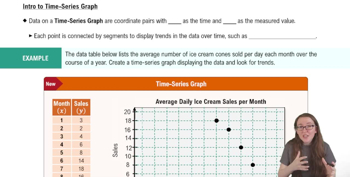
Creating Time-Series Graphs

Statistical Inference

Statistical inference involves using data from a sample to make generalizations or predictions about a population. This process relies on probability theory to ensure that the conclusions drawn from the sample are valid and can be applied to the larger group, making sampling a powerful tool in research.
Recommended video:
Guided course
05:53
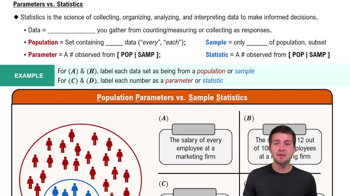
Parameters vs. Statistics