Ch. 1 - Introduction to Statistics
Larson - Elementary Statistics: Picturing the World 8th Edition
Larson8th EditionElementary Statistics: Picturing the WorldISBN: 9780137493470Not the one you use?Change textbook
Chapter 1, Problem 1.1.43

Which part of the survey described in Exercise 31 represents the descriptive branch of statistics? What conclusions might be drawn from the survey using inferential statistics?

Verified step by step guidance
1
Identify the descriptive branch of statistics: Descriptive statistics involves summarizing and organizing the data collected in the survey. Look for any numerical summaries, graphs, or tables that describe the data, such as averages, percentages, or frequency distributions.
Determine the specific data summaries provided in Exercise 31: Review the survey results to find examples of descriptive statistics, such as the mean, median, mode, or standard deviation of the data collected.
Understand inferential statistics: Inferential statistics involves using the data from the survey to make generalizations or predictions about a larger population. This typically includes hypothesis testing, confidence intervals, or regression analysis.
Identify potential conclusions using inferential statistics: Based on the survey data, consider what broader insights or predictions could be made about the population. For example, if the survey sampled customer satisfaction, inferential statistics might predict overall satisfaction levels for all customers.
Connect the descriptive and inferential branches: Explain how the descriptive statistics provide the foundation for the inferential analysis. Descriptive statistics summarize the data, while inferential statistics use that summary to draw conclusions about the population.

Verified video answer for a similar problem:

This video solution was recommended by our tutors as helpful for the problem above.
Video duration:
3m
Was this helpful?

Key Concepts

Here are the essential concepts you must grasp in order to answer the question correctly.

Descriptive Statistics

Descriptive statistics involves summarizing and organizing data to describe its main features. This can include measures such as mean, median, mode, and standard deviation, as well as graphical representations like histograms and pie charts. The goal is to provide a clear overview of the data set without making predictions or inferences about a larger population.
Recommended video:
Guided course
05:53
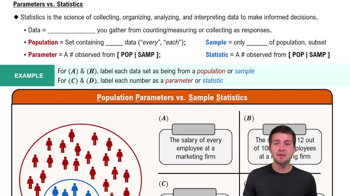
Parameters vs. Statistics

Inferential Statistics

Inferential statistics allows researchers to make conclusions about a population based on a sample of data. It involves using probability theory to estimate population parameters, test hypotheses, and make predictions. Common techniques include confidence intervals and hypothesis tests, which help determine the reliability of the conclusions drawn from the sample data.
Recommended video:
Guided course
05:53
Parameters vs. Statistics

Survey Methodology

Survey methodology refers to the techniques and principles used to collect data through surveys. This includes designing questions, selecting a sample, and determining the mode of administration (e.g., online, face-to-face). Understanding survey methodology is crucial for interpreting the results accurately and ensuring that the data collected is representative of the target population.
Recommended video:
Guided course
03:06
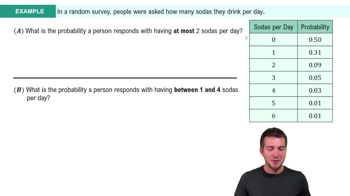
Intro to Random Variables & Probability Distributions Example 1