Skip to main content
Introductory Statistics
My Course
Learn
Exam Prep
AI Tutor
Study Guides
Textbook Solutions
Flashcards
Explore
Try the app
My Course
Learn
Exam Prep
AI Tutor
Study Guides
Textbook Solutions
Flashcards
Explore
Try the app
Back
Non-Standard Normal Distribution quiz
You can tap to flip the card.
What are the mean and standard deviation of the standard normal distribution?
You can tap to flip the card.
👆
What are the mean and standard deviation of the standard normal distribution?
The mean (μ) is zero and the standard deviation (σ) is one.
Track progress
Control buttons has been changed to "navigation" mode.
1/15
Related flashcards
Related practice
Recommended videos
Non-Standard Normal Distribution definitions
Non-Standard Normal Distribution
15 Terms
Non-Standard Normal Distribution
6. Normal Distribution and Continuous Random Variables
5 problems
Topic
Laura
6. Normal Distribution and Continuous Random Variables
4 topics
12 problems
Chapter
Justin
Guided course
06:21
Finding Z-Scores for Non-Standard Normal Variables Example 1
5
views
Guided course
04:05
Finding Values of Non-Standard Normal Variables from Probabilities
3
views
Guided course
03:17
Finding Z-Scores for Non-Standard Normal Variables
4
views
Terms in this set (15)
Hide definitions
What are the mean and standard deviation of the standard normal distribution?
The mean (μ) is zero and the standard deviation (σ) is one.
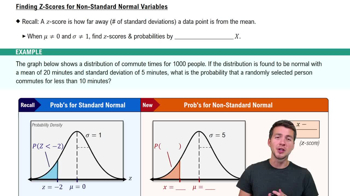
What equation do you use to convert a value from a nonstandard normal distribution to a z-score?
You use z = (x - μ) / σ.
If a normal distribution has μ = 20 and σ = 5, what is the z-score for x = 10?
The z-score is (10 - 20) / 5 = -2.
Why do we convert nonstandard normal values to z-scores?
We convert them so we can use the standard normal table or calculator to find probabilities.
What does a z-score represent in a normal distribution?
It represents how many standard deviations a value is from the mean.
How do you find the probability that a value is less than a certain x in a nonstandard normal distribution?
First, convert x to a z-score, then use the z-table to find the probability.
What is the formula to find an x value given a z-score in a nonstandard normal distribution?
The formula is x = z * σ + μ.
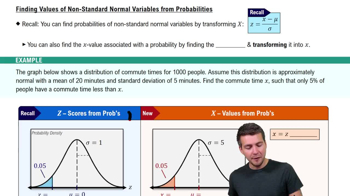
If 5% of values are below a certain x in a normal distribution with μ = 20 and σ = 5, what is the first step to find x?
First, find the z-score that corresponds to a cumulative probability of 0.05.
What is the z-score associated with the lowest 5% of a standard normal distribution?
The z-score is approximately -1.64.
How do you use the z-score to find the corresponding x value in a nonstandard normal distribution?
Multiply the z-score by the standard deviation and add the mean: x = z * σ + μ.
What is the x value below which 5% of commute times fall if μ = 20 and σ = 5?
The x value is x = (-1.64) * 5 + 20 = 11.8.
What does the area to the left of a z-score represent in a normal distribution?
It represents the probability that a value is less than the corresponding x value.
Why is it useful to standardize a nonstandard normal distribution?
Standardizing allows us to use standard normal tables and methods to solve probability problems.
What is the general process for finding probabilities in a nonstandard normal distribution?
Convert x to a z-score, then use the standard normal table to find the probability.
How do you solve for x when given a probability in a nonstandard normal distribution?
Find the z-score for the probability, then use x = z * σ + μ to solve for x.
 BackBack
 06:21
06:21