Statistics
My Course
Learn
Exam Prep
AI Tutor
Study Guides
Textbook Solutions
Flashcards
Explore
Try the app
My Course
Learn
Exam Prep
AI Tutor
Study Guides
Textbook Solutions
Flashcards
Explore
Try the app
Back
Interpreting Standard Deviation definitions
You can tap to flip the card.
Standard Deviation
You can tap to flip the card.
👆
Standard Deviation
Quantifies how much data values differ from the mean, indicating the degree of spread or clustering in a dataset.
Track progress
Control buttons has been changed to "navigation" mode.
1/15
Related flashcards
Related practice
Recommended videos
Interpreting Standard Deviation quiz #1
Interpreting Standard Deviation
10 Terms
3. Describing Data Numerically
4 topics
11 problems
Chapter
David-Paige
05:42
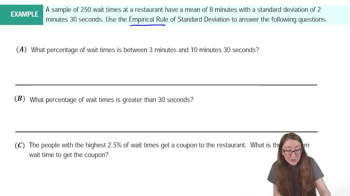
Empirical Rule of Standard Deviation and Range Rule of Thumb Example 1
1
views
01:56
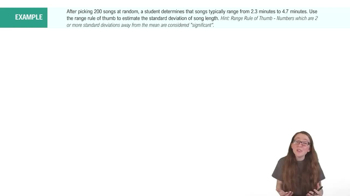
Empirical Rule of Standard Deviation and Range Rule of Thumb Example 2
1
views
07:10
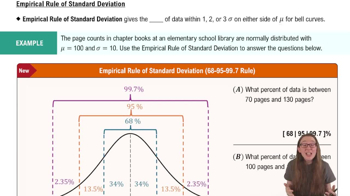
Empirical Rule of Standard Deviation and Range Rule of Thumb
1
views
Terms in this set (15)
Hide definitions
Standard Deviation
Quantifies how much data values differ from the mean, indicating the degree of spread or clustering in a dataset.
Mean
Represents the central value of a dataset, around which data points are distributed and compared.
Normal Distribution
Describes a symmetric, bell-shaped curve where data is evenly distributed around the mean.
Empirical Rule
Estimates the percentage of data within one, two, and three standard deviations of the mean in a normal distribution.
Bell Curve
Visualizes a normal distribution, showing symmetry and concentration of data around the mean.
Interval
Defines a range between two values, often measured in standard deviations from the mean.
Significance
Indicates a data value that is unusually high or low compared to the expected range in a dataset.
Range Rule of Thumb
Identifies values as significant if they are two or more standard deviations away from the mean.
Symmetry
Ensures equal distribution of data on both sides of the mean in a normal distribution.
Outlier
Refers to a data point that lies far from the mean, often outside two standard deviations.
Percentile
Expresses the proportion of data below a certain value, useful for interpreting spread in a normal distribution.
Clustering
Describes data points grouped closely together, often indicated by a small standard deviation.
Dispersion
Measures how widely data points are spread out from the mean, reflected by a large standard deviation.
Tail
Represents the extreme ends of a distribution, where significant or rare values are found.
Sixty-Eight Ninety-Five Ninety-Nine Point Seven Rule
Summarizes the empirical rule percentages for data within one, two, and three standard deviations of the mean.