Skip to main content
Statistics
My Course
Learn
Exam Prep
AI Tutor
Study Guides
Textbook Solutions
Flashcards
Explore
Try the app
My Course
Learn
Exam Prep
AI Tutor
Study Guides
Textbook Solutions
Flashcards
Explore
Try the app
Back
Inferences for the Correlation Coefficient - Excel definitions
You can tap to flip the card.
Correlation Coefficient
You can tap to flip the card.
👆
Correlation Coefficient
A numerical measure indicating the strength and direction of a linear relationship between two variables in a dataset.
Track progress
Control buttons has been changed to "navigation" mode.
1/15
Related flashcards
Related practice
Recommended videos
Inferences for the Correlation Coefficient - Excel quiz
Inferences for the Correlation Coefficient - Excel
15 Terms
11. Correlation
2 topics
4 problems
Chapter
Zachary
05:45
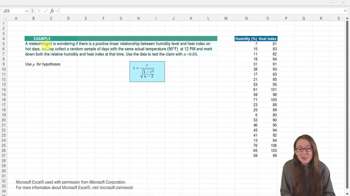
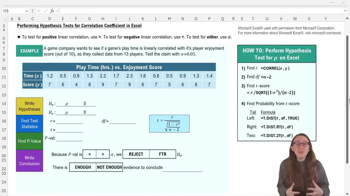
Inferences for Correlation Coefficient - Excel
1
views
05:40
Inferences for Correlation Coefficient - Excel Example 1
4
views
Terms in this set (15)
Hide definitions
Correlation Coefficient
A numerical measure indicating the strength and direction of a linear relationship between two variables in a dataset.
Population Correlation Coefficient
A parameter representing the true linear relationship between two variables across an entire population.
Sample Correlation Coefficient
A statistic calculated from sample data to estimate the strength and direction of a linear relationship.
Null Hypothesis
A statement asserting no linear correlation exists between two variables, often represented by a population parameter equal to zero.
Alternative Hypothesis
A claim suggesting a linear correlation exists between two variables, differing from the null hypothesis.
Degrees of Freedom
A value calculated as sample size minus two, used in statistical tests for correlation significance.
Test Statistic
A calculated value used to assess the evidence against the null hypothesis in hypothesis testing.
T Score
A value derived from the sample correlation coefficient and degrees of freedom, used to determine statistical significance.
P Value
A probability indicating the likelihood of observing the sample data if the null hypothesis is true.
Alpha
A threshold probability used to decide whether to reject the null hypothesis, commonly set at 0.05.
Two-Tailed Test
A hypothesis test evaluating whether a parameter differs from a specified value in either direction.
Linear Correlation
A relationship where changes in one variable are associated with proportional changes in another variable.
Excel Function
A built-in formula used to compute statistical values such as correlation coefficients and p-values.
R Squared
A value obtained by squaring the correlation coefficient, representing the proportion of variance explained.
Significance
A determination that observed results are unlikely to have occurred by chance, based on statistical testing.
 BackBack
 05:45
05:45