Statistics
My Course
Learn
Exam Prep
AI Tutor
Study Guides
Textbook Solutions
Flashcards
Explore
Try the app
My Course
Learn
Exam Prep
AI Tutor
Study Guides
Textbook Solutions
Flashcards
Explore
Try the app
Back
Confidence Intervals for Population Variance definitions
You can tap to flip the card.
Confidence Interval
You can tap to flip the card.
👆
Confidence Interval
A range of values calculated from sample data that likely contains the true population parameter with a specified probability.
Track progress
Control buttons has been changed to "navigation" mode.
1/15
Related flashcards
Related practice
Recommended videos
Confidence Intervals for Population Variance quiz #1
Confidence Intervals for Population Variance
10 Terms
8. Sampling Distributions & Confidence Intervals: Proportion
1 topic
3 problems
Chapter
Ernest
Guided course
06:44
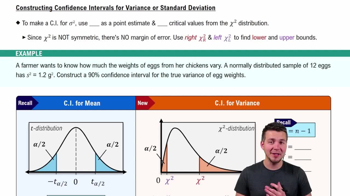
Constructing Confidence Intervals for Variance or Standard Deviation
Guided course
04:11
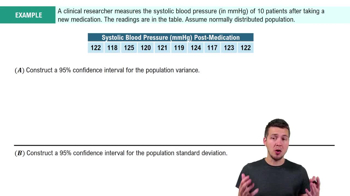
Constructing Confidence Intervals for Variance or Standard Deviation Example 2
Guided course
05:53
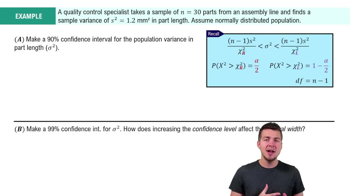
Constructing Confidence Intervals for Variance or Standard Deviation Example 1
Terms in this set (15)
Hide definitions
Confidence Interval
A range of values calculated from sample data that likely contains the true population parameter with a specified probability.
Population Variance
A measure of how data points in a population are spread out, estimated using sample variance and chi-square methods.
Standard Deviation
A statistic representing the average distance of data points from the mean, found by taking the square root of variance.
Chi-Square Distribution
An asymmetrical probability distribution used to construct intervals for variance and standard deviation.
Critical Value
A threshold from the chi-square table that determines the bounds of a confidence interval for variance.
Degrees of Freedom
A value calculated as sample size minus one, used to locate critical values in the chi-square table.
Sample Variance
A point estimate for population variance, calculated from sample data and used in confidence interval formulas.
Chi-Square Table
A reference chart listing critical values for the chi-square distribution based on degrees of freedom and area.
Lower Bound
The smallest value in a confidence interval, calculated using the higher chi-square critical value in the denominator.
Upper Bound
The largest value in a confidence interval, calculated using the lower chi-square critical value in the denominator.
Point Estimate
A single value derived from sample data that serves as the best guess for a population parameter.
Confidence Level
The probability that the constructed interval contains the true population parameter, often expressed as a percentage.
Alpha
The complement of the confidence level, representing the total probability outside the interval.
Bracket Notation
A format for expressing confidence intervals, showing the lower and upper bounds as a pair of values.
Normal Distribution
A symmetric, bell-shaped distribution required for valid confidence interval calculations for variance.