Ch. 7 - Hypothesis Testing with One Sample
Larson - Elementary Statistics: Picturing the World 8th Edition
Larson8th EditionElementary Statistics: Picturing the WorldISBN: 9780137493470Not the one you use?Change textbook
Chapter 7, Problem 7.1.54

Getting at the Concept Explain why a level of significance of α=0 is not used.

Verified step by step guidance
1
A level of significance (α) represents the probability of rejecting the null hypothesis when it is actually true (Type I error). Setting α=0 would mean that there is zero probability of making a Type I error.
If α=0, it implies that we would never reject the null hypothesis, regardless of the evidence provided by the data. This would make hypothesis testing meaningless because we would always accept the null hypothesis.
In practical terms, data often contains variability and uncertainty. Even with strong evidence against the null hypothesis, setting α=0 would prevent us from making any conclusions, as no amount of evidence could lead to rejecting the null hypothesis.
The purpose of hypothesis testing is to balance the risks of Type I and Type II errors. By setting α to a small, non-zero value (e.g., 0.05), we allow for a controlled and acceptable level of Type I error while still being able to make meaningful decisions based on the data.
Therefore, a level of significance of α=0 is not used because it would eliminate the ability to reject the null hypothesis, rendering the statistical test ineffective and impractical.

Verified video answer for a similar problem:

This video solution was recommended by our tutors as helpful for the problem above.
Video duration:
1m
Was this helpful?

Key Concepts

Here are the essential concepts you must grasp in order to answer the question correctly.

Level of Significance

The level of significance, denoted as α, is the threshold for determining whether to reject the null hypothesis in hypothesis testing. It represents the probability of making a Type I error, which occurs when the null hypothesis is incorrectly rejected. Common values for α are 0.05 or 0.01, indicating a 5% or 1% risk of error, respectively.
Recommended video:
03:33
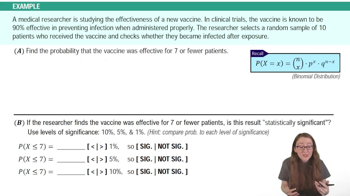
Finding Binomial Probabilities Using TI-84 Example 1

Type I Error

A Type I error happens when a true null hypothesis is rejected, leading to a false positive conclusion. This error is directly related to the level of significance; a lower α reduces the likelihood of committing this error. Setting α to 0 would mean no risk of Type I error, but it would also prevent any rejection of the null hypothesis, making hypothesis testing ineffective.
Recommended video:
Guided course
04:24
Types of Data

Hypothesis Testing

Hypothesis testing is a statistical method used to make inferences about a population based on sample data. It involves formulating a null hypothesis (H0) and an alternative hypothesis (H1), then using sample data to determine whether there is enough evidence to reject H0. A level of significance is crucial in this process, as it guides the decision-making regarding the hypotheses.
Recommended video:
Guided course
06:21
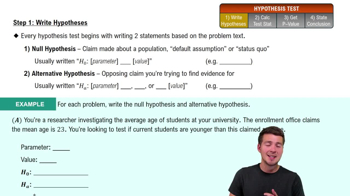
Step 1: Write Hypotheses
Related Practice
Textbook Question

Finding Critical Values and Rejection Regions In Exercises 23–28, find the critical value(s) and rejection region(s) for the type of z-test with level of significance α. Include a graph with your answer.


Two-tailed test, α = 0.12

Textbook Question

In Exercises 15–22, test the claim about the population variance or standard deviation at the level of significance Assume the population is normally distributed.

Claim: σ^2=63, α=0.01 . Sample statistics: s^2=58, n=29

Textbook Question

Stating the Null and Alternative Hypotheses In Exercises 25–30, write the claim as a mathematical statement. State the null and alternative hypotheses, and identify which represents the claim.


Paying for College According to a recent survey, 54% of today’s college students used student loans to pay for college.

Textbook Question

Graphical Analysis In Exercises 17–20, match the alternative hypothesis with its graph. Then state the null hypothesis and sketch its graph.


Ha: μ > 3


Textbook Question

True or False? In Exercises 5–10, determine whether the statement is true or false. If it is false, rewrite it as a true statement.


The level of significance is the maximum probability you allow for rejecting a null hypothesis when it is actually true.

Textbook Question

Identifying the Nature of a Hypothesis Test In Exercises 37–42, state and in words and in symbols. Then determine whether the hypothesis test is left-tailed, right-tailed, or two-tailed. Explain your reasoning. Sketch a normal sampling distribution and shade the area for the P-value.


High School Graduation Rate A high school claims that its mean graduation rate is more than 97%.