
Textbook Question
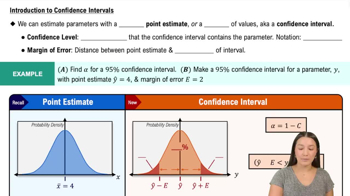
In Exercises 3–6, construct the indicated confidence interval for the population mean . Which distribution did you use to create the confidence interval?
c=0.90, x̅=8.21, σ=0.62, n=8
 Verified step by step guidance
 06:33
06:33
 08:45
08:45 07:01
07:01In Exercises 3–6, construct the indicated confidence interval for the population mean . Which distribution did you use to create the confidence interval?
c=0.90, x̅=8.21, σ=0.62, n=8
[APPLET] The annual earnings (in dollars) for 30 randomly selected locksmiths are shown below. Assume the population is normally distributed. (Adapted from Salary.com)
48,69446,85642,91261,67271,11254,861
69,45471,84159,75169,61254,28452,166
66,36048,16465,27235,25061,12765,397
58,92558,91659,01753,07045,19969,941
69,49257,08553,82952,69268,29853,792
Construct a 95% confidence interval for the population mean annual earnings for locksmiths.
In Exercises 7–10, the statement represents a claim. Write its complement and state which is Ho and which is Ha.
σ=0.63
Take this quiz as you would take a quiz in class. After you are done, check your work against the answers given in the back of the book.For each exercise, perform the steps below.
a. Identify the claim and state Ho and Ha
b. Determine whether the hypothesis test is left-tailed, right-tailed, or two-tailed, and whether to use a z-test or a t-test. Explain your reasoning.
c. Find the critical value(s) and identify the rejection region(s).
d. Find the appropriate standardized test statistic.
e. Decide whether to reject or fail to reject the null hypothesis.
f. Interpret the decision in the context of the original claim.
[APPLET] The table shows the credit scores for 12 randomly selected adults who are considered high-risk borrowers before and two years after they attend a personal finance seminar. At α=0.01, is there enough evidence to support the claim that the personal finance seminar helps adults increase their credit scores? Assume the populations are normally distributed.
Take this quiz as you would take a quiz in class. After you are done, check your work against the answers given in the back of the book.For each exercise, perform the steps below.
a. Identify the claim and state Ho and Ha
b. Determine whether the hypothesis test is left-tailed, right-tailed, or two-tailed, and whether to use a z-test or a t-test. Explain your reasoning.
c. Find the critical value(s) and identify the rejection region(s).
d. Find the appropriate standardized test statistic.
e. Decide whether to reject or fail to reject the null hypothesis.
f. Interpret the decision in the context of the original claim.
A music teacher claims that the mean scores on a music assessment test for eighth grade students in public and private schools are equal. The mean score for 13 randomly selected public school students is 146 with a standard deviation of 49, and the mean score for 15 randomly selected private school students is 160 with a standard deviation of 42. At α=0.1, can you reject the teacher’s claim? Assume the populations are normally distributed and the population variances are equal. (Adapted from National Center for Education Statistics)
[APPLET] The annual earnings (in dollars) for 30 randomly selected locksmiths are shown below. Assume the population is normally distributed. (Adapted from Salary.com)
48,69446,85642,91261,67271,11254,861
69,45471,84159,75169,61254,28452,166
66,36048,16465,27235,25061,12765,397
58,92558,91659,01753,07045,19969,941
69,49257,08553,82952,69268,29853,792
A researcher claims that the mean annual earnings for locksmiths is \$55,000. At α=0.05, can you reject the researcher’s claim? Interpret the decision in the context of the original claim.