
Ch. 2 - Descriptive Statistics
Larson - Elementary Statistics: Picturing the World 8th Edition
Larson8th EditionElementary Statistics: Picturing the WorldISBN: 9780137493470Not the one you use?Change textbook
Chapter 2, Problem 2.T.5b

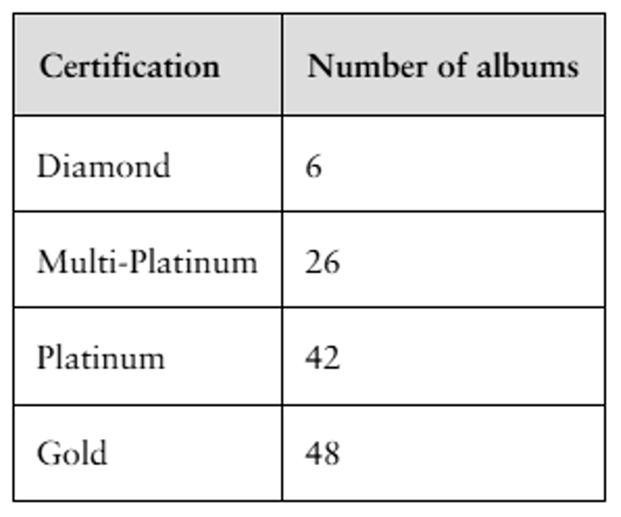
The table lists the number of albums by The Beatles that received sales certifications. Display the data using (b) a Pareto chart. (Source: Recording Industry Association of America)
Pareto chart showing The Beatles' album sales certifications: Gold 48, Platinum 42, Multi-Platinum 26, Diamond 6.

Verified step by step guidance
1
Step 1: Understand the concept of a Pareto chart. A Pareto chart is a type of bar graph where the bars are arranged in descending order of frequency or importance. It often includes a cumulative percentage line to show the proportion of the total represented by the bars.
Step 2: Organize the data in descending order based on the number of albums. From the table, the order will be: Gold (48), Platinum (42), Multi-Platinum (26), Diamond (6).
Step 3: Calculate the cumulative frequency for each category. Start with the highest frequency (Gold) and add the frequencies sequentially: Gold (48), Gold + Platinum (48 + 42 = 90), Gold + Platinum + Multi-Platinum (90 + 26 = 116), and finally Gold + Platinum + Multi-Platinum + Diamond (116 + 6 = 122).
Step 4: Compute the cumulative percentage for each category. Divide each cumulative frequency by the total number of albums (122) and multiply by 100 to get the percentage. For example, Gold cumulative percentage = (48 / 122) * 100.
Step 5: Create the Pareto chart. Plot the bars for each category in descending order of frequency (Gold, Platinum, Multi-Platinum, Diamond). Overlay a cumulative percentage line on the chart, starting at the first bar and increasing as you move to the next category.

Verified video answer for a similar problem:

This video solution was recommended by our tutors as helpful for the problem above.
Video duration:
5m
Was this helpful?

Key Concepts

Here are the essential concepts you must grasp in order to answer the question correctly.

Pareto Chart

A Pareto chart is a type of bar graph that represents the frequency or impact of problems in a process, arranged in descending order. It is based on the Pareto principle, which states that roughly 80% of effects come from 20% of causes. In this context, the chart will visually display the number of albums by The Beatles that received different sales certifications, highlighting the most significant categories.
Recommended video:
04:52
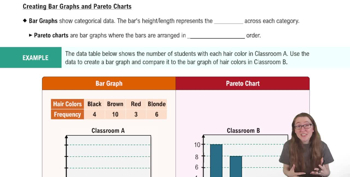
Creating Bar Graphs and Pareto Charts

Sales Certifications

Sales certifications are awards given to music albums based on the number of copies sold. Common certifications include Gold, Platinum, Multi-Platinum, and Diamond, each representing different sales thresholds. Understanding these certifications is crucial for interpreting the data, as they indicate the commercial success of The Beatles' albums.
Recommended video:
04:13
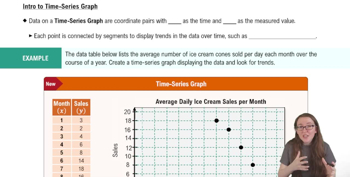
Creating Time-Series Graphs

Data Visualization

Data visualization is the graphical representation of information and data. By using visual elements like charts and graphs, complex data sets can be made more accessible and understandable. In this case, creating a Pareto chart will help to quickly convey the distribution of album certifications, allowing for easier comparison and analysis of The Beatles' sales performance.
Recommended video:
Guided course
04:39
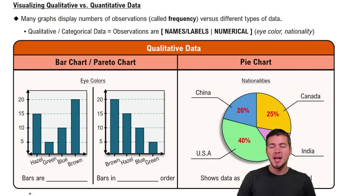
Visualizing Qualitative vs. Quantitative Data
Related Practice
Textbook Question

The data set represents the number of movies that a sample of 20 people watched in a year.

121 148 94 142 170 88 221 106 18 67

149 28 60 101 134 168 92 154 53 66

b. Display the data using a frequency histogram and a frequency polygon on the same axes.

Textbook Question

"According to data from the city of Toronto, Ontario, Canada, there were nearly 112,000 parking infractions in the city for December 2020, with fines totaling over 5,500,000 Canadian dollars. The fines (in Canadian dollars) for a random sample of 105 parking infractions in Toronto, Ontario, Canada, for December 2020 are listed below. (Source: City of Toronto)


In Exercises 1–5, use technology. If possible, print your results.


Draw a histogram for the data. Does the distribution appear to be bell-shaped?"

Textbook Question

Use the frequency distribution in Exercise 4 to estimate the sample mean and sample standard deviation of the data. Do the formulas for grouped data give results that are as accurate as the individual entry formulas? Explain.

Textbook Question

The mean gestational length of a sample of 208 horses is 343.7 days, with a standard deviation of 10.4 days. The data set has a bell-shaped distribution.


b. Determine whether a gestational length of 318.4 days is unusual.

Textbook Question

The number of minutes it took 12 students in a statistics class to complete the final exam are listed. Use a scatter plot to display this data set and the data set in Exercise 1. The data sets are in the same order. Describe any patterns.

61 85 67 48 54 61 59 80 67 55 88 84

Textbook Question

The data set represents the number of movies that a sample of 20 people watched in a year.

121 148 94 142 170 88 221 106 18 67

149 28 60 101 134 168 92 154 53 66


c. Display the data using a relative frequency histogram.