Ch. 3 - Describing, Exploring, and Comparing Data
Triola - Elementary Statistics 14th Edition
Triola14th EditionElementary StatisticsISBN: 9780137366446Not the one you use?Change textbook
Chapter 3, Problem 3.1.13

Critical Thinking. For Exercises 5–20, watch out for these little buggers. Each of these exercises involves some feature that is somewhat tricky. Find the (a) mean, (b) median, (c) mode, (d) midrange, and then answer the given question.


Caffeine in Soft Drinks Listed below are measured amounts of caffeine (mg per 12 oz of drink) obtained in one can from each of 20 brands (7-UP, A&W Root Beer, Cherry Coke, . . . , Tab). Are the statistics representative of the population of all cans of the same 20 brands consumed by Americans?


0 0 34 34 34 45 41 51 55 36 47 41 0 0 53 54 38 0 41 47

Verified step by step guidance
1
Step 1: Organize the data. Start by listing the caffeine values in ascending order: 0, 0, 0, 0, 34, 34, 34, 36, 38, 41, 41, 41, 45, 47, 47, 51, 53, 54, 55, 47.
Step 2: Calculate the mean. Add all the caffeine values together and divide by the total number of data points (n = 20). Use the formula: xn, where x is the sum of all data points.
Step 3: Find the median. Since there are 20 data points (even number), the median is the average of the 10th and 11th values in the ordered list. Identify these values and compute their average.
Step 4: Determine the mode. The mode is the value(s) that appear most frequently in the dataset. Count the frequency of each value to identify the mode(s).
Step 5: Calculate the midrange. The midrange is the average of the smallest and largest values in the dataset. Use the formula: min+max2. Then, consider whether the statistics are representative of the population by discussing potential biases or limitations in the data collection process.

Verified video answer for a similar problem:

This video solution was recommended by our tutors as helpful for the problem above.
Video duration:
1m
Was this helpful?

Key Concepts

Here are the essential concepts you must grasp in order to answer the question correctly.

Descriptive Statistics

Descriptive statistics summarize and describe the main features of a dataset. This includes measures such as the mean (average), median (middle value), mode (most frequent value), and midrange (average of the highest and lowest values). These statistics provide a quick overview of the data's central tendency and variability, which is essential for understanding the distribution of caffeine levels in the given soft drinks.
Recommended video:
Guided course
05:53
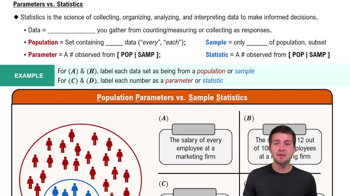
Parameters vs. Statistics

Population vs. Sample

In statistics, a population refers to the entire group of individuals or items that we want to study, while a sample is a subset of that population. The question asks whether the statistics calculated from the 20 brands are representative of all cans consumed by Americans, highlighting the importance of understanding how well a sample reflects the broader population. This concept is crucial for making inferences about the population based on sample data.
Recommended video:
05:11
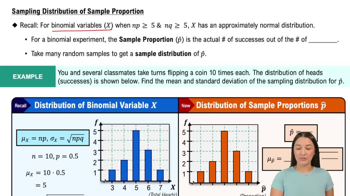
Sampling Distribution of Sample Proportion

Statistical Inference

Statistical inference involves using data from a sample to make conclusions about a larger population. It includes techniques such as hypothesis testing and confidence intervals. In the context of the question, determining if the caffeine statistics are representative requires evaluating whether the sample of 20 brands can reliably inform us about the caffeine content in all cans of those brands consumed by Americans, which is a key aspect of inferential statistics.
Recommended video:
Guided course
05:53
Parameters vs. Statistics
Related Practice
Textbook Question

In Exercises 21–24, find the mean and median for each of the two samples, then compare the two sets of results.


It’s a Small Wait After All Listed below are the wait times (minutes) at 10 AM for the rides “It’s a Small World” and “Avatar Flight of Passage.” These data are found in Data Set 33 “Disney World Wait Times.” Does a comparison between the means and medians reveal that there is a difference between the two sets of data?

Textbook Question

Critical Thinking. For Exercises 5–20, watch out for these little buggers. Each of these exercises involves some feature that is somewhat tricky. Find the (a) mean, (b) median, (c) mode, (d) midrange, and then answer the given question.


Smart Thermostats Listed below are selling prices (dollars) of smart thermostats tested by Consumer Reports magazine. If you decide to buy one of these smart thermostats, what statistic is most relevant, other than the measures of central tendency?


250 170 225 100 250 250 130 200 150 250 170 200 180 250

1
views
Textbook Question

Estimating Standard Deviation with the Range Rule of Thumb. In Exercises 29–32, refer to the data in the indicated exercise. After finding the range of the data, use the range rule of thumb to estimate the value of the standard deviation. Compare the result to the standard deviation computed using all of the data.


Body Temperatures Refer to Data Set 5 “Body Temperatures” in Appendix B and use the body temperatures for 12:00 AM on day 2.

Textbook Question

In Exercises 21–28, use the same list of cell phone radiation levels given for Exercises 17–20. Find the indicated percentile or quartile.


P30


Textbook Question

In Exercises 5–20, find the range, variance, and standard deviation for the given sample data. Include appropriate units (such as “minutes”) in your results. (The same data were used in Section 3-1, where we found measures of center. Here we find measures of variation.) Then answer the given questions.


Super Bowl Jersey Numbers Listed below are the jersey numbers of the 11 offensive players on the starting roster of the New England Patriots when they won Super Bowl LIII. What do the results tell us?


12 26 46 15 11 87 77 62 60 69 61

Textbook Question

In Exercises 21–28, use the same list of cell phone radiation levels given for Exercises 17–20. Find the indicated percentile or quartile.


P50