
Ch. 3 - Describing, Exploring, and Comparing Data
Triola - Elementary Statistics 14th Edition
Triola14th EditionElementary StatisticsISBN: 9780137366446Not the one you use?Change textbook
Chapter 3, Problem 3.3.21

In Exercises 21–28, use the same list of cell phone radiation levels given for Exercises 17–20. Find the indicated percentile or quartile.


P30


Verified step by step guidance
1
Step 1: Arrange the data in ascending order. The data provided in the image is already sorted in ascending order, so no further action is needed for this step.
Step 2: Determine the position of the 30th percentile (P30) using the formula: P=k×n100, where k is the percentile (30 in this case) and n is the total number of data points.
Step 3: Count the total number of data points in the dataset. From the image, there are 40 data points.
Step 4: Calculate the position of P30 using the formula. Substitute k = 30 and n = 40 into the formula to find the position.
Step 5: Locate the value corresponding to the calculated position in the sorted dataset. If the position is not an integer, interpolate between the two closest values.

Verified video answer for a similar problem:

This video solution was recommended by our tutors as helpful for the problem above.
Video duration:
2m
Was this helpful?

Key Concepts

Here are the essential concepts you must grasp in order to answer the question correctly.

Percentiles

A percentile is a measure used in statistics to indicate the value below which a given percentage of observations fall. For example, the 30th percentile (P30) is the value below which 30% of the data points lie. To find a specific percentile, the data must be ordered from least to greatest, and then the appropriate position can be calculated using the formula: P = (n + 1) * (percentile/100), where n is the number of data points.

Quartiles

Quartiles are specific percentiles that divide a dataset into four equal parts. The first quartile (Q1) represents the 25th percentile, the second quartile (Q2) is the median or 50th percentile, and the third quartile (Q3) is the 75th percentile. Quartiles help summarize the distribution of data and are useful for identifying outliers and understanding the spread of the dataset.
Recommended video:
Guided course
04:51
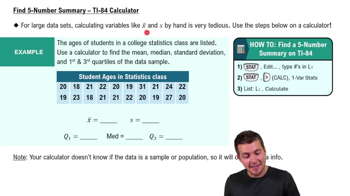
Find 5-Number Summary - TI-84 Calculator

Data Ordering

Data ordering is the process of arranging data points in a specific sequence, typically from smallest to largest. This step is crucial for calculating percentiles and quartiles, as it allows for accurate identification of the position of values within the dataset. Properly ordered data ensures that statistical measures reflect the true distribution and characteristics of the data being analyzed.
Recommended video:
Guided course
04:39
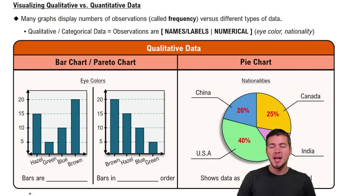
Visualizing Qualitative vs. Quantitative Data
Related Practice
Textbook Question

In Exercises 21–24, find the mean and median for each of the two samples, then compare the two sets of results.


It’s a Small Wait After All Listed below are the wait times (minutes) at 10 AM for the rides “It’s a Small World” and “Avatar Flight of Passage.” These data are found in Data Set 33 “Disney World Wait Times.” Does a comparison between the means and medians reveal that there is a difference between the two sets of data?

Textbook Question

In Exercises 21–24, find the mean and median for each of the two samples, then compare the two sets of results.


Blood Pressure A sample of blood pressure measurements is taken from Data Set 1 “Body Data” in Appendix B, and those values (mm Hg) are listed below. The values are matched so that 10 subjects each have systolic and diastolic measurements. (Systolic is a measure of the force of blood being pushed through arteries, but diastolic is a measure of blood pressure when the heart is at rest between beats.) Are the measures of center the best statistics to use with these data? What else might be better?

Systolic: 118 128 158 96 156 122 116 136 126 120

Diastolic: 80  76  74  52  90  88  58   64  72  82

1
views
Textbook Question

Estimating Standard Deviation with the Range Rule of Thumb. In Exercises 29–32, refer to the data in the indicated exercise. After finding the range of the data, use the range rule of thumb to estimate the value of the standard deviation. Compare the result to the standard deviation computed using all of the data.


Body Temperatures Refer to Data Set 5 “Body Temperatures” in Appendix B and use the body temperatures for 12:00 AM on day 2.

Textbook Question

In Exercises 5–20, find the range, variance, and standard deviation for the given sample data. Include appropriate units (such as “minutes”) in your results. (The same data were used in Section 3-1, where we found measures of center. Here we find measures of variation.) Then answer the given questions.


Super Bowl Jersey Numbers Listed below are the jersey numbers of the 11 offensive players on the starting roster of the New England Patriots when they won Super Bowl LIII. What do the results tell us?


12 26 46 15 11 87 77 62 60 69 61

Textbook Question

Critical Thinking. For Exercises 5–20, watch out for these little buggers. Each of these exercises involves some feature that is somewhat tricky. Find the (a) mean, (b) median, (c) mode, (d) midrange, and then answer the given question.


Caffeine in Soft Drinks Listed below are measured amounts of caffeine (mg per 12 oz of drink) obtained in one can from each of 20 brands (7-UP, A&W Root Beer, Cherry Coke, . . . , Tab). Are the statistics representative of the population of all cans of the same 20 brands consumed by Americans?


0 0 34 34 34 45 41 51 55 36 47 41 0 0 53 54 38 0 41 47

1
views
Textbook Question

Large Data Sets from Appendix B. In Exercises 25–28, refer to the indicated data set in Appendix B. Use software or a calculator to find the means and medians.


Weights Use the weights of the males listed in Data Set 2 “ANSUR I 1988,” which were measured in 1988 and use the weights of the males listed in Data Set 3 “ANSUR II 2012,” which were measured in 2012. Does it appear that males have become heavier?