
Ch. 9 - Correlation and Regression
Larson - Elementary Statistics: Picturing the World 8th Edition
Larson8th EditionElementary Statistics: Picturing the WorldISBN: 9780137493470Not the one you use?Change textbook
Chapter 9, Problem 9.1.1

1. Two variables have a positive linear correlation. Does the dependent variable increase or decrease as the independent variable increases? What if the variables have a negative linear correlation?

Verified step by step guidance
1
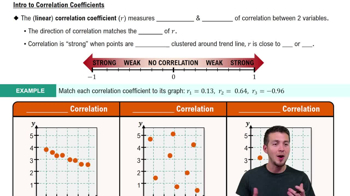
Understand the concept of correlation: Correlation measures the strength and direction of a linear relationship between two variables. A positive correlation means that as one variable increases, the other variable tends to increase as well. A negative correlation means that as one variable increases, the other variable tends to decrease.
Identify the relationship in the case of a positive linear correlation: When two variables have a positive linear correlation, the dependent variable increases as the independent variable increases. This is because the relationship is directly proportional.
Identify the relationship in the case of a negative linear correlation: When two variables have a negative linear correlation, the dependent variable decreases as the independent variable increases. This is because the relationship is inversely proportional.
Visualize the relationships: In a scatterplot, a positive linear correlation would show points trending upward from left to right, while a negative linear correlation would show points trending downward from left to right.
Summarize the key takeaway: For a positive linear correlation, the dependent variable increases with the independent variable. For a negative linear correlation, the dependent variable decreases with the independent variable.

Verified video answer for a similar problem:

This video solution was recommended by our tutors as helpful for the problem above.
Video duration:
3m
Was this helpful?

Key Concepts

Here are the essential concepts you must grasp in order to answer the question correctly.

Linear Correlation

Linear correlation measures the strength and direction of a linear relationship between two variables. A positive correlation indicates that as one variable increases, the other variable also tends to increase, while a negative correlation suggests that as one variable increases, the other tends to decrease. This relationship is quantified using the correlation coefficient, which ranges from -1 to 1.
Recommended video:
Guided course
05:43
Correlation Coefficient

Dependent and Independent Variables

In statistical analysis, the independent variable is the one that is manipulated or changed to observe its effect on another variable, known as the dependent variable. The dependent variable responds to changes in the independent variable. Understanding this distinction is crucial for interpreting the results of correlation and regression analyses.
Recommended video:
Guided course
06:28
Independence Test

Positive vs. Negative Correlation

A positive correlation means that both variables move in the same direction; as one increases, the other also increases. Conversely, a negative correlation indicates that the variables move in opposite directions; as one increases, the other decreases. Recognizing these patterns helps in predicting outcomes and understanding relationships between variables in data analysis.
Recommended video:
Guided course
05:43
Correlation Coefficient
Related Practice
Textbook Question

"Predicting y-Values In Exercises 3-6, use the multiple regression equation to predict the y-values for the values of the independent variables.

3. Cauliflower Yield The equation used to predict the annual cauliflower yield (in pounds

per acre) is y=24,791+4.508x_1-4.723x_2

where x_1 is the number of acres planted and x_2 is the number of acres harvested.(Adapted from United States Department of Agriculture)

a. x_1 = 36,500, x_2 = 36,100

b. x_1 = 38,100, x_2 = 37,800

c. x_1 = 39,000, x_2 = 38,800

d. x_1 = 42,200, x_2 = 42,100"

Textbook Question

"In Exercises 19-22, two variables are given that have been shown to have correlation but no cause-and-effect relationship. Describe at least one possible reason for the correlation.

20. Alcohol use and tobacco use"

Textbook Question

"Predicting y-Values In Exercises 3-6, use the multiple regression equation to predict the y-values for the values of the independent variables.

5. Black Cherry Tree Volume The volume (in cubic feet) of a black cherry tree can be modeled by the equation

y =- 52.2+0.3x_1 +4.5x_2

where x_1 is the tree's height (in feet) and x_2 is the tree's diameter (in inches). (Source: Journal of the Royal Statistical Society)

a. x_1 = 70, x_2 = 8.6

b. x_1 = 65, x_2 = 11.0

c. x_1 = 83, x_2 = 17.6

d. x_1 = 87, x_2 = 19.6"

Textbook Question

"Constructing and Interpreting a Prediction Interval In Exercises 21-30, construct the indicated prediction interval and interpret the results.

25. Mean Wage Construct a 99% prediction interval for the mean annual wage in Exercise 15 when the percentage of employment in STEM occupations is 13% in the industry."

Textbook Question

"Constructing and Interpreting a Prediction Interval In Exercises 21-30, construct the indicated prediction interval and interpret the results.

23. Points Earned Construct a 90% prediction interval for total points earned in Exercise 13 when the number of goals allowed by the team is 140."

Textbook Question

1. Interpret the meaning of the coefficient -8.2 in the multiple regression equation y=112.1+0.43x_1-8.2x_2+29.5x_3.