Ch. 9 - Correlation and Regression
Larson - Elementary Statistics: Picturing the World 8th Edition
Larson8th EditionElementary Statistics: Picturing the WorldISBN: 9780137493470Not the one you use?Change textbook
Chapter 9, Problem 9.4.3

"Predicting y-Values In Exercises 3-6, use the multiple regression equation to predict the y-values for the values of the independent variables.
3. Cauliflower Yield The equation used to predict the annual cauliflower yield (in pounds
per acre) is y=24,791+4.508x_1-4.723x_2
where x_1 is the number of acres planted and x_2 is the number of acres harvested.(Adapted from United States Department of Agriculture)
a. x_1 = 36,500, x_2 = 36,100
b. x_1 = 38,100, x_2 = 37,800
c. x_1 = 39,000, x_2 = 38,800
d. x_1 = 42,200, x_2 = 42,100"

Verified step by step guidance
1
Identify the multiple regression equation given: y = 24791 + 4.508x_1 - 4.723x_2, where x_1 is the number of acres planted and x_2 is the number of acres harvested.
For each set of values of x_1 and x_2, substitute these values into the regression equation. For example, for part (a), substitute x_1 = 36500 and x_2 = 36100.
Perform the multiplication for each term involving the independent variables: multiply 4.508 by x_1 and multiply -4.723 by x_2.
Add the constant term 24791 to the results of the multiplications to calculate the predicted value of y (the cauliflower yield) for each case.
Repeat steps 2 to 4 for each set of values given in parts (b), (c), and (d) to find the predicted yields for all scenarios.

Verified video answer for a similar problem:

This video solution was recommended by our tutors as helpful for the problem above.
Video duration:
4m
Was this helpful?

Key Concepts

Here are the essential concepts you must grasp in order to answer the question correctly.

Multiple Regression Equation

A multiple regression equation models the relationship between one dependent variable and two or more independent variables. It predicts the dependent variable (y) by combining the independent variables (x₁, x₂, etc.) multiplied by their coefficients, plus a constant term. This allows for understanding how changes in each independent variable affect the outcome.
Recommended video:
Guided course
07:01
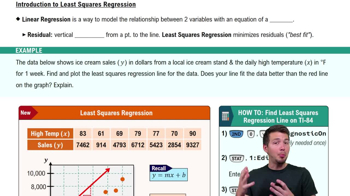
Intro to Least Squares Regression

Interpreting Coefficients in Regression

Each coefficient in a regression equation represents the expected change in the dependent variable for a one-unit increase in the corresponding independent variable, holding other variables constant. Positive coefficients indicate a direct relationship, while negative coefficients indicate an inverse relationship.
Recommended video:
Guided course
06:14
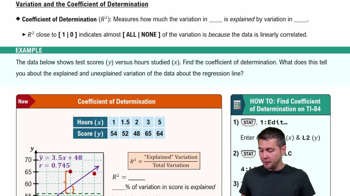
Coefficient of Determination

Predicting Values Using Regression

To predict y-values, substitute the given values of independent variables into the regression equation and perform the arithmetic operations. This process estimates the dependent variable based on the model, enabling practical forecasting or decision-making.
Recommended video:
Guided course
04:57
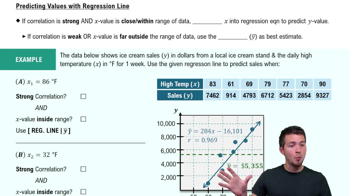
Using Regression Lines to Predict Values