Ch. 10 - Correlation and Regression
Triola - Elementary Statistics 14th Edition
Triola14th EditionElementary StatisticsISBN: 9780137366446Not the one you use?Change textbook
Chapter 10, Problem 10.2.22

Regression and Predictions
Exercises 13–28 use the same data sets as Exercises 13–28 in Section 10-1.


Find the regression equation, letting the first variable be the predictor (x) variable.
Find the indicated predicted value by following the prediction procedure summarized in Figure 10-5.
Subway and the CPI Use the subway/CPI data from the preceding exercise. What is the best predicted value of the CPI when the subway fare is \$3.00?

Verified step by step guidance
1
Identify the predictor variable (x) and the response variable (y). In this case, the subway fare is the predictor variable (x), and the Consumer Price Index (CPI) is the response variable (y).
Use the given data set to calculate the regression equation. The regression equation is typically of the form y = mx + b, where m is the slope and b is the y-intercept. To find m and b, use the formulas: m = (Σ(xy) - n(μx)(μy)) / (Σ(x²) - n(μx²)) and b = μy - m(μx), where μx and μy are the means of x and y, respectively.
Substitute the calculated values of m (slope) and b (intercept) into the regression equation to obtain the final equation.
To predict the CPI when the subway fare is \$3.00, substitute x = 3.00 into the regression equation y = mx + b. This will give the predicted value of y (CPI).
Verify the prediction by ensuring that the value of x = 3.00 lies within the range of the data set used to calculate the regression equation. If it does, the prediction is valid; otherwise, it may be an extrapolation and less reliable.

Verified video answer for a similar problem:

This video solution was recommended by our tutors as helpful for the problem above.
Video duration:
4m
Was this helpful?

Key Concepts

Here are the essential concepts you must grasp in order to answer the question correctly.

Regression Analysis

Regression analysis is a statistical method used to model the relationship between a dependent variable and one or more independent variables. In this context, it helps to determine how changes in the predictor variable (subway fare) affect the predicted value of the response variable (CPI). The output is typically a regression equation that can be used for making predictions.

Predictor and Response Variables

In regression analysis, the predictor variable (independent variable) is the one used to predict the value of another variable, known as the response variable (dependent variable). In this case, the subway fare is the predictor variable, while the Consumer Price Index (CPI) is the response variable. Understanding the roles of these variables is crucial for interpreting the regression results.
Recommended video:
Guided course
07:09
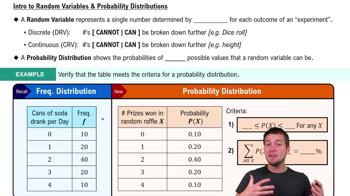
Intro to Random Variables & Probability Distributions

Prediction Procedure

The prediction procedure involves using the regression equation to estimate the value of the response variable based on a specific value of the predictor variable. This typically includes substituting the predictor value into the regression equation to calculate the predicted response. In this scenario, the procedure will be applied to find the CPI when the subway fare is set at $3.00.
Recommended video:
Guided course
03:50
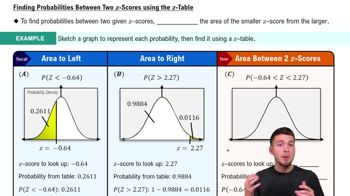
Probabilities Between Two Values
Related Practice
Textbook Question

Finding the Best Model

In Exercises 5–16, construct a scatterplot and identify the mathematical model that best fits the given data. Assume that the model is to be used only for the scope of the given data, and consider only linear, quadratic, logarithmic, exponential, and power models.

Richter Scale The table lists different amounts (metric tons) of the explosive TNT and the corresponding value measured on the Richter scale resulting from explosions of the TNT.

1
views
Textbook Question

Response and Predictor Variables Using all of the Tour de France bicycle race results up to a recent year, we get this multiple regression equation: Speed = 29.2-0.00260Distance + 0.540Stages + 0.0570Finishers, where Speed is the mean speed of the winner (km/h), Distance is the length of the race (km), Stages is the number of stages in the race, and Finishers is the number of bicyclists who finished the race. Identify the response and predictor variables.

3
views
Textbook Question

Regression and Predictions

Exercises 13–28 use the same data sets as Exercises 13–28 in Section 10-1.


Find the regression equation, letting the first variable be the predictor (x) variable.

Find the indicated predicted value by following the prediction procedure summarized in Figure 10-5.


Powerball Jackpots and Tickets Sold Listed below are the same data from Table 10-1 in the Chapter Problem, but an additional pair of values has been added from actual Powerball results. (Jackpot amounts are in millions of dollars, ticket sales are in millions.) Find the best predicted number of tickets sold when the jackpot was actually 345 million dollars. How does the result compare to the value of 55 million tickets that were actually sold?


Textbook Question

Finding the Equation of the Regression Line

In Exercises 9 and 10, use the given data to find the equation of the regression line. Examine the scatterplot and identify a characteristic of the data that is ignored by the regression line.


[IMAGE]

4
views
Textbook Question

Coefficient of Determination Using the heights and weights described in Exercise 1, the linear correlation coefficient r is 0.394. Find the value of the coefficient of determination. What practical information does the coefficient of determination provide?

4
views
Textbook Question

Standard Error of Estimate A random sample of 118 different female statistics students is obtained and their weights are measured in kilograms and in pounds. Using the 118 paired weights (weight in kg, weight in lb), what is the value of se? For a female statistics student who weighs 100 lb, the predicted weight in kilograms is 45.4 kg. What is the 95% prediction interval?