
Textbook Question
F Test Statistic
a. If s2,1 represents the larger of two sample variances, can the F test statistic ever be less than 1?

 Verified step by step guidance
 06:21
06:21
 04:46
04:46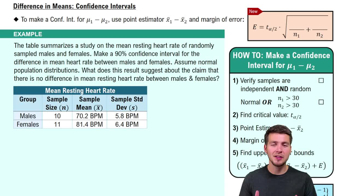 08:21
08:21F Test Statistic
a. If s2,1 represents the larger of two sample variances, can the F test statistic ever be less than 1?
Smoking Cessation Programs
a. Construct the confidence interval that could be used to test the claim in Exercise 5. What feature of the confidence interval leads to the same conclusion from Exercise 5?
Body Temperatures Listed below are body temperatures from six different subjects measured at two different times in a day (from Data Set 5 “Body Temperatures” in Appendix B).
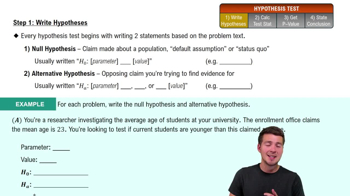
b. Identify the null and alternative hypotheses for using the sample data to test the claim that the differences between 8 AM temperatures and 12 AM temperatures are from a population with a mean equal to 0°F
In Exercises 5–16, use the listed paired sample data, and assume that the samples are simple random samples and that the differences have a distribution that is approximately normal.
The Freshman 15 The “Freshman 15” refers to the belief that college students gain 15 lb (or 6.8 kg) during their freshman year. Listed below are weights (kg) of randomly selected male college freshmen (from Data Set 13 “Freshman 15” in Appendix B). The weights were measured in September and later in April.
a. Use a 0.01 significance level to test the claim that for the population of freshman male college students, the weights in September are less than the weights in the following April.
Variation of Hospital Times Use the sample data given in Exercise 7 “Seat Belts” and test the claim that for children hospitalized after motor vehicle crashes, the numbers of days in intensive care units for those wearing seat belts and for those not wearing seat belts have the same variation. Use a 0.05 significance level.
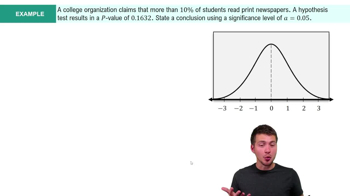
Smoking Cessation Programs Among 198 smokers who underwent a “sustained care” program, 51 were no longer smoking after six months. Among 199 smokers who underwent a “standard care” program, 30 were no longer smoking after six months (based on data from “Sustained Care Intervention and Postdischarge Smoking Cessation Among Hospitalized Adults,” by Rigotti et al., Journal of the American Medical Association, Vol. 312, No. 7). We want to use a 0.01 significance level to test the claim that the rate of success for smoking cessation is greater with the sustained care program. Test the claim using a hypothesis test.