
Ch. 9 - Inferences from Two Samples
Triola - Elementary Statistics 14th Edition
Triola14th EditionElementary StatisticsISBN: 9780137366446Not the one you use?Change textbook
Chapter 9, Problem 9.RE.10

Variation of Hospital Times Use the sample data given in Exercise 7 “Seat Belts” and test the claim that for children hospitalized after motor vehicle crashes, the numbers of days in intensive care units for those wearing seat belts and for those not wearing seat belts have the same variation. Use a 0.05 significance level.

Verified step by step guidance
1
Identify the two independent samples: one group of children who were wearing seat belts and another group who were not, with their respective numbers of days spent in intensive care units (ICU).
State the null hypothesis \(H_0\): the variances of the two groups are equal, i.e., \(\sigma_1^2 = \sigma_2^2\), and the alternative hypothesis \(H_a\): the variances are not equal, i.e., \(\sigma_1^2 \neq \sigma_2^2\).
Calculate the sample variances \(s_1^2\) and \(s_2^2\) for the two groups using the formula \(s^2 = \frac{1}{n-1} \sum (x_i - \bar{x})^2\), where \(n\) is the sample size and \(\bar{x}\) is the sample mean for each group.
Compute the test statistic for comparing variances, which is the F-ratio: \(F = \frac{s_1^2}{s_2^2}\), where \(s_1^2\) is the larger sample variance to ensure \(F \geq 1\).
Determine the critical value(s) from the F-distribution table at the 0.05 significance level with degrees of freedom \(df_1 = n_1 - 1\) and \(df_2 = n_2 - 1\), then compare the calculated \(F\) to the critical value(s) to decide whether to reject or fail to reject the null hypothesis.

Verified video answer for a similar problem:

This video solution was recommended by our tutors as helpful for the problem above.
Video duration:
5m
Was this helpful?

Key Concepts

Here are the essential concepts you must grasp in order to answer the question correctly.

Variance and Variation

Variance measures the spread or dispersion of data points around the mean, indicating how much the values differ from each other. Understanding variance is essential to compare the variability in hospital stay durations between children who wore seat belts and those who did not.
Recommended video:
Guided course
04:48
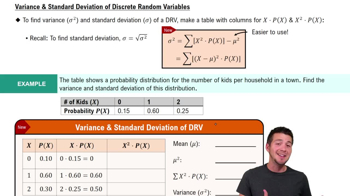
Variance & Standard Deviation of Discrete Random Variables

F-Test for Equality of Variances

The F-test is a statistical method used to compare the variances of two independent samples to determine if they differ significantly. It involves calculating the ratio of the two sample variances and comparing it to a critical value based on the chosen significance level.
Recommended video:
Guided course
04:48
Variance & Standard Deviation of Discrete Random Variables

Significance Level and Hypothesis Testing

The significance level (alpha) defines the threshold for rejecting the null hypothesis, commonly set at 0.05. Hypothesis testing involves stating a null hypothesis (equal variances) and an alternative hypothesis (unequal variances), then using sample data to decide whether to reject the null based on the test statistic.
Recommended video:
05:52
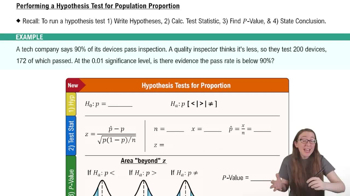
Performing Hypothesis Tests: Proportions
Related Practice
Textbook Question

Forecast and Actual Temperatures Listed below are actual temperatures (°F) along with the temperatures that were forecast five days earlier (data collected by the author). Use a 0.05 significance level to test the claim that differences between actual temperatures and temperatures forecast five days earlier are from a population with a mean of 0°F.

Textbook Question

F Test Statistic


a. If s2,1 represents the larger of two sample variances, can the F test statistic ever be less than 1?


Textbook Question

Smoking Cessation Programs


a. Construct the confidence interval that could be used to test the claim in Exercise 5. What feature of the confidence interval leads to the same conclusion from Exercise 5?

Textbook Question

In Exercises 5–16, use the listed paired sample data, and assume that the samples are simple random samples and that the differences have a distribution that is approximately normal.


The Freshman 15 The “Freshman 15” refers to the belief that college students gain 15 lb (or 6.8 kg) during their freshman year. Listed below are weights (kg) of randomly selected male college freshmen (from Data Set 13 “Freshman 15” in Appendix B). The weights were measured in September and later in April.


a. Use a 0.01 significance level to test the claim that for the population of freshman male college students, the weights in September are less than the weights in the following April.

Textbook Question

Pulse Rates of Women and Men Using the samples of women and men included in Data Set 1 “Body Data,” we get this 95% confidence interval estimate of the difference between the population mean of pulse rates (bpm) of women and the population mean of pulse rates (bpm) of men: 1.7 bpm < u1-u2 < 7.2bpm. In this confidence interval, women correspond to population 1 and men correspond to population 2.


a. What does the confidence interval suggest about equality of the mean pulse rate of women and the mean pulse rate of men?

Textbook Question

Smoking Cessation Programs Among 198 smokers who underwent a “sustained care” program, 51 were no longer smoking after six months. Among 199 smokers who underwent a “standard care” program, 30 were no longer smoking after six months (based on data from “Sustained Care Intervention and Postdischarge Smoking Cessation Among Hospitalized Adults,” by Rigotti et al., Journal of the American Medical Association, Vol. 312, No. 7). We want to use a 0.01 significance level to test the claim that the rate of success for smoking cessation is greater with the sustained care program. Test the claim using a hypothesis test.