Ch. 5 - Normal Probability Distributions
Larson - Elementary Statistics: Picturing the World 8th Edition
Larson8th EditionElementary Statistics: Picturing the WorldISBN: 9780137493470Not the one you use?Change textbook
Chapter 5, Problem 5.4.19

Interpreting the Central Limit Theorem In Exercises 19–26, find the mean and standard deviation of the indicated sampling distribution of sample means. Then sketch a graph of the sampling distribution.


Renewable Energy During a recent period of two years, the day-ahead prices for renewable energy in Germany (in euros per mega-watt hour) have a mean of 31.58 and a standard deviation of 12.293. Random samples of size 75 are drawn from this population, and the mean of each sample is determined.

Verified step by step guidance
1
Step 1: Recall the Central Limit Theorem (CLT). The CLT states that for a sufficiently large sample size, the sampling distribution of the sample mean will be approximately normal, regardless of the population's distribution. The mean of the sampling distribution will equal the population mean, and the standard deviation of the sampling distribution (known as the standard error) will be the population standard deviation divided by the square root of the sample size.
Step 2: Identify the given values from the problem. The population mean (μ) is 31.58, the population standard deviation (σ) is 12.293, and the sample size (n) is 75.
Step 3: Calculate the mean of the sampling distribution. According to the CLT, the mean of the sampling distribution is the same as the population mean. Therefore, the mean of the sampling distribution is μ = 31.58.
Step 4: Calculate the standard error of the sampling distribution. The formula for the standard error (SE) is: SE=σn. Substitute the given values: SE=12.29375.
Step 5: Sketch the graph of the sampling distribution. Since the sample size is large (n = 75), the sampling distribution of the sample mean will be approximately normal. Draw a bell-shaped curve centered at the mean (31.58) with the standard error calculated in Step 4 representing the spread of the distribution.

Verified video answer for a similar problem:

This video solution was recommended by our tutors as helpful for the problem above.
Video duration:
1m
Was this helpful?

Key Concepts

Here are the essential concepts you must grasp in order to answer the question correctly.

Central Limit Theorem (CLT)

The Central Limit Theorem states that the distribution of the sample means will approach a normal distribution as the sample size increases, regardless of the population's distribution, provided the sample size is sufficiently large (typically n ≥ 30). This theorem is fundamental in statistics as it allows for the use of normal probability techniques to make inferences about population parameters based on sample statistics.
Recommended video:
Guided course
04:52
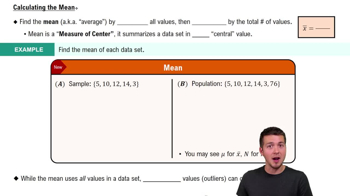
Calculating the Mean

Sampling Distribution

A sampling distribution is the probability distribution of a statistic (like the sample mean) obtained from a large number of samples drawn from a specific population. It describes how the sample means vary from sample to sample and is crucial for understanding the variability and reliability of estimates derived from sample data.
Recommended video:
05:11
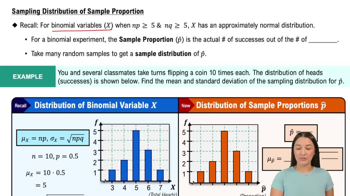
Sampling Distribution of Sample Proportion

Mean and Standard Deviation of Sampling Distribution

The mean of the sampling distribution of sample means is equal to the population mean, while the standard deviation (known as the standard error) is calculated by dividing the population standard deviation by the square root of the sample size (σ/√n). These measures help quantify the expected behavior of sample means and are essential for constructing confidence intervals and conducting hypothesis tests.
Recommended video:
05:11
Sampling Distribution of Sample Proportion