
Ch. 6 - Normal Probability Distributions
Triola - Elementary Statistics 14th Edition
Triola14th EditionElementary StatisticsISBN: 9780137366446Not the one you use?Change textbook
Chapter 6, Problem 6.c.2

In Exercises 1 and 2, use the following wait times (minutes) at 10:00 AM for the Tower of Terror ride at Disney World (from Data Set 33 “Disney World Wait Times” in Appendix B).


35 35 20 50 95 75 45 50 30 35 30 30


Tower of Terror Wait Times


a. Find Q1, Q2 and Q3.

Verified step by step guidance
1
Step 1: Organize the data in ascending order. The given wait times are: 35, 35, 20, 50, 95, 75, 45, 50, 30, 35, 30, 30. Arrange them in increasing order: 20, 30, 30, 30, 35, 35, 35, 45, 50, 50, 75, 95.
Step 2: Identify the median (Q2). The median is the middle value of the ordered data. Since there are 12 data points (even number), the median is the average of the 6th and 7th values in the ordered list. Locate the 6th and 7th values, which are both 35, and calculate their average.
Step 3: Find Q1 (the first quartile). Q1 is the median of the lower half of the data (the first 6 values in the ordered list: 20, 30, 30, 30, 35, 35). Identify the middle value of this subset, which is the average of the 3rd and 4th values.
Step 4: Find Q3 (the third quartile). Q3 is the median of the upper half of the data (the last 6 values in the ordered list: 35, 45, 50, 50, 75, 95). Identify the middle value of this subset, which is the average of the 3rd and 4th values.
Step 5: Summarize the results. Q1, Q2, and Q3 represent the first quartile, median, and third quartile, respectively. These values divide the data into four equal parts, providing insights into the distribution of the wait times.

Verified video answer for a similar problem:

This video solution was recommended by our tutors as helpful for the problem above.
Video duration:
3m
Was this helpful?

Key Concepts

Here are the essential concepts you must grasp in order to answer the question correctly.

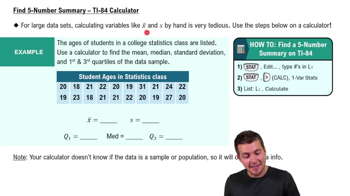
Quartiles

Quartiles are values that divide a data set into four equal parts, each containing 25% of the data. The first quartile (Q1) is the median of the lower half of the data, the second quartile (Q2) is the overall median, and the third quartile (Q3) is the median of the upper half. These measures help summarize the distribution of the data and identify its spread.
Recommended video:
Guided course
04:51
Find 5-Number Summary - TI-84 Calculator

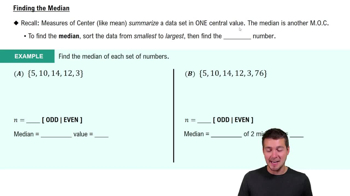
Median

The median is the middle value of a data set when it is ordered from least to greatest. If the number of observations is odd, the median is the middle number; if even, it is the average of the two middle numbers. The median is a robust measure of central tendency, less affected by outliers than the mean.
Recommended video:
Guided course
03:26
Calculating the Median

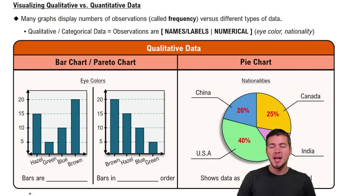
Data Set Ordering

Ordering a data set involves arranging the values in ascending or descending order, which is essential for calculating quartiles and medians. This process allows for a clear understanding of the data's distribution and helps in identifying key statistical measures, such as Q1, Q2, and Q3, which are based on the ordered values.
Recommended video:
Guided course
04:39
Visualizing Qualitative vs. Quantitative Data
Related Practice
Textbook Question

Continuity Correction In testing the assumption that the probability of a baby boy is 0.512, a geneticist obtains a random sample of 1000 births and finds that 502 of them are boys. Using the continuity correction, describe the area under the graph of a normal distribution corresponding to the following. (For example, the area corresponding to “the probability of at least 502 boys” is this: the area to the right of 501.5.)


c. The probability of more than 502 boys

Textbook Question

In Exercises 1 and 2, use the following wait times (minutes) at 10:00 AM for the Tower of Terror ride at Disney World (from Data Set 33 “Disney World Wait Times” in Appendix B).


35 35 20 50 95 75 45 50 30 35 30 30


d. Find the variance.

Textbook Question

In Exercises 1 and 2, use the following wait times (minutes) at 10:00 AM for the Tower of Terror ride at Disney World (from Data Set 33 “Disney World Wait Times” in Appendix B).


35 35 20 50 95 75 45 50 30 35 30 30


g. What level of measurement (nominal, ordinal, interval, ratio) describes this data set?

6
views
Textbook Question

In Exercises 7–10, use the same population of {4, 5, 9} that was used in Examples 2 and 5. As in Examples 2 and 5, assume that samples of size n = 2 are randomly selected with replacement.


c. Find the mean of the sampling distribution of the sample variance.

1
views
Textbook Question

Sleepwalking Assume that 29.2% of people have sleepwalked (based on “Prevalence and Comorbidity of Nocturnal Wandering in the U.S. Adult General Population, by Ohayon et al., Neurology, Vol. 78, No. 20). Assume that in a random sample of 1480 adults, 455 have sleepwalked.


c. What does the result suggest about the rate of 29.2%?

Textbook Question

Ergonomics. Exercises 9–16 involve applications to ergonomics, as described in the Chapter Problem.


Safe Loading of Elevators The elevator in the car rental building at San Francisco International Airport has a placard stating that the maximum capacity is “4000 lb—27 passengers.” Because 4000/27=148, this converts to a mean passenger weight of 148 lb when the elevator is full. We will assume a worst-case scenario in which the elevator is filled with 27 adult males. Based on Data Set 1 “Body Data” in Appendix B, assume that adult males have weights that are normally distributed with a mean of 189 lb and a standard deviation of 39 lb.


c. What do you conclude about the safety of this elevator?