Ch. 3 - Probability
Larson - Elementary Statistics: Picturing the World 8th Edition
Larson8th EditionElementary Statistics: Picturing the WorldISBN: 9780137493470Not the one you use?Change textbook
Chapter 3, Problem 3.R.17

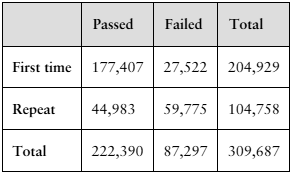
In Exercises 17 and 18, use the table, which shows the numbers of first-time and repeat U.S. nursing students taking the National Council Licensure Examination (NCLEX-RN® exam) to pass or fail in a recent year. (Adapted from National Council Licensure Examinations)
Table showing the number of first-time and repeat nursing students who passed or failed the NCLEX-RN exam.
17. Find the probability that a student took the exam for the first time, given that the student failed.

Verified step by step guidance
1
Step 1: Understand the problem. We are tasked with finding the conditional probability that a student took the exam for the first time, given that the student failed. This is a conditional probability problem, and the formula for conditional probability is P(A|B) = P(A ∩ B) / P(B).
Step 2: Identify the relevant data from the table. The number of students who failed the exam is 87,297 (this is P(B)). Out of these, the number of first-time students who failed is 27,522 (this is P(A ∩ B)).
Step 3: Write the formula for the conditional probability. Using the formula P(A|B) = P(A ∩ B) / P(B), substitute the values: P(First-time | Failed) = 27,522 / 87,297.
Step 4: Simplify the fraction. Divide the numerator (27,522) by the denominator (87,297) to calculate the probability. This will give the proportion of students who took the exam for the first time among those who failed.
Step 5: Interpret the result. The final value represents the likelihood that a student who failed the exam was taking it for the first time. Ensure the result is expressed as a decimal or percentage for clarity.

Verified video answer for a similar problem:

This video solution was recommended by our tutors as helpful for the problem above.
Video duration:
4m
Was this helpful?

Key Concepts

Here are the essential concepts you must grasp in order to answer the question correctly.

Conditional Probability

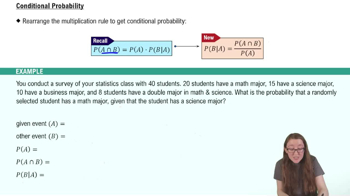
Conditional probability refers to the likelihood of an event occurring given that another event has already occurred. In this context, we are interested in finding the probability that a student is a first-time test taker, given that they failed the NCLEX-RN exam. This is calculated using the formula P(A|B) = P(A and B) / P(B), where A is the event of being a first-time taker and B is the event of failing.
Recommended video:
03:53
Conditional Probability Rule

Joint Probability

Joint probability is the probability of two events happening at the same time. In this scenario, it refers to the probability that a student both failed the exam and is a first-time test taker. This is important for calculating conditional probabilities, as it provides the numerator in the conditional probability formula.
Recommended video:
5:37
Introduction to Probability

Total Probability

Total probability is the sum of the probabilities of all possible outcomes of an event. In this case, to find the probability of failing the exam, we need to consider both first-time and repeat test takers. The total number of failures is used as the denominator in the conditional probability formula, allowing us to determine the likelihood of a student being a first-time taker among those who failed.
Recommended video:
5:37
Introduction to Probability
Related Practice
Textbook Question

In Exercises 45-48, use combinations and permutations.

48. An employer must hire 2 people from a list of 13 applicants. In how many ways can the employer choose to hire the two people?
Textbook Question

"In Exercises 17 and 18, use the table, which shows the numbers of first-time and repeat U.S. nursing students taking the National Council Licensure Examination (NCLEX-RN® exam) to pass or fail in a recent year. (Adapted from National Council Licensure Examinations)

18. Find the probability that a student passed, given that the student repeated the exam."

Textbook Question

In Exercises 49-53, use counting principles to find the probability.

50. A security code consists of three letters and one digit. The first letter cannot be A, B, or C. What is the probability of guessing the security code on the first try?

Textbook Question

In Exercises 49-53, use counting principles to find the probability.

52. A class of 40 students takes a statistics exam. The results are shown in the table at the left. Three students are selected at random. What is the probability that

d. all three students received a B or a C?

Textbook Question

In Exercises 49-53, use counting principles to find the probability.

52. A class of 40 students takes a statistics exam. The results are shown in the table at the left. Three students are selected at random. What is the probability that

b. all three students received a C or better?

Textbook Question

In Exercises 49-53, use counting principles to find the probability.

53. A corporation has six male senior executives and four female senior executives. Four senior executives are chosen at random to attend a technology seminar. What is the

probability of choosing

b. four women?