Ch. 3 - Probability
Larson - Elementary Statistics: Picturing the World 8th Edition
Larson8th EditionElementary Statistics: Picturing the WorldISBN: 9780137493470Not the one you use?Change textbook
Chapter 3, Problem 3.R.53b

In Exercises 49-53, use counting principles to find the probability.
53. A corporation has six male senior executives and four female senior executives. Four senior executives are chosen at random to attend a technology seminar. What is the
probability of choosing
b. four women?

Verified step by step guidance
1
Step 1: Understand the problem. We are tasked with finding the probability of selecting 4 women out of 4 chosen senior executives, given there are 6 male and 4 female senior executives in total. This is a problem involving combinations and probability.
Step 2: Calculate the total number of ways to choose 4 senior executives from the 10 available (6 males + 4 females). Use the combination formula: \( \binom{n}{r} = \frac{n!}{r!(n-r)!} \), where \( n \) is the total number of items and \( r \) is the number of items to choose.
Step 3: Calculate the number of ways to choose 4 women from the 4 available women. Again, use the combination formula \( \binom{n}{r} \). Here, \( n = 4 \) and \( r = 4 \).
Step 4: Compute the probability by dividing the number of favorable outcomes (choosing 4 women) by the total number of possible outcomes (choosing any 4 executives). The formula for probability is \( P = \frac{\text{favorable outcomes}}{\text{total outcomes}} \).
Step 5: Simplify the fraction obtained in Step 4 to express the probability in its simplest form.

Verified video answer for a similar problem:

This video solution was recommended by our tutors as helpful for the problem above.
Video duration:
4m
Was this helpful?

Key Concepts

Here are the essential concepts you must grasp in order to answer the question correctly.

Counting Principles

Counting principles, such as the fundamental counting principle, permutations, and combinations, are essential for determining the number of ways to select items from a set. In this context, combinations are particularly relevant as they allow us to calculate the number of ways to choose a specific number of executives from a larger group without regard to the order of selection.
Recommended video:
04:04
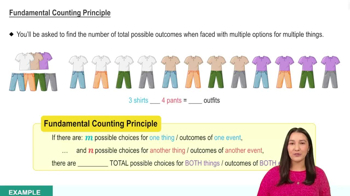
Fundamental Counting Principle

Combinations

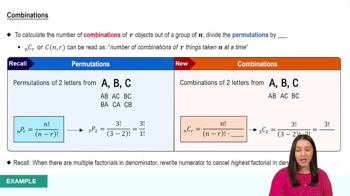
Combinations refer to the selection of items from a larger set where the order does not matter. The formula for combinations is given by C(n, k) = n! / (k!(n-k)!), where n is the total number of items, k is the number of items to choose, and '!' denotes factorial. This concept is crucial for calculating the number of ways to choose four women from the four available female executives.
Recommended video:
05:22
Combinations

Probability

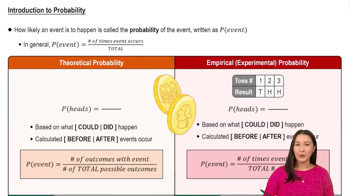
Probability is a measure of the likelihood of an event occurring, expressed as a ratio of favorable outcomes to the total number of possible outcomes. In this scenario, the probability of selecting four women involves calculating the number of ways to choose four women and dividing it by the total number of ways to choose any four executives from the ten total executives.
Recommended video:
5:37
Introduction to Probability
Related Practice
Textbook Question

In Exercises 17 and 18, use the table, which shows the numbers of first-time and repeat U.S. nursing students taking the National Council Licensure Examination (NCLEX-RN® exam) to pass or fail in a recent year. (Adapted from National Council Licensure Examinations)

17. Find the probability that a student took the exam for the first time, given that the student failed.

Textbook Question

In Exercises 45-48, use combinations and permutations.

48. An employer must hire 2 people from a list of 13 applicants. In how many ways can the employer choose to hire the two people?

Textbook Question

In Exercises 7-12, classify the statement as an example of classical probability, empirical probability, or subjective probability. Explain your reasoning.

11. The probability of rolling 2 six-sided dice and getting a sum of 9 is 1/9.

Textbook Question

"In Exercises 17 and 18, use the table, which shows the numbers of first-time and repeat U.S. nursing students taking the National Council Licensure Examination (NCLEX-RN® exam) to pass or fail in a recent year. (Adapted from National Council Licensure Examinations)

18. Find the probability that a student passed, given that the student repeated the exam."

Textbook Question

In Exercises 5 and 6, use the Fundamental Counting Principle.

6. The state of Virginia's license plates have three letters and four digits. Assuming that any letter or digit can be used, how many different license plates are possible?

Textbook Question

In Exercises 49-53, use counting principles to find the probability.

50. A security code consists of three letters and one digit. The first letter cannot be A, B, or C. What is the probability of guessing the security code on the first try?