
Ch. 9 - Inferences from Two Samples
Triola - Elementary Statistics 14th Edition
Triola14th EditionElementary StatisticsISBN: 9780137366446Not the one you use?Change textbook
Chapter 9, Problem 9.4.1a

F Test Statistic


a. If s2,1 represents the larger of two sample variances, can the F test statistic ever be less than 1?

Verified step by step guidance
1
Understand the F-test statistic formula: The F-test statistic is calculated as F = (s²₁ / s²₂), where s²₁ is the larger sample variance and s²₂ is the smaller sample variance.
Recognize the condition in the problem: By definition, s²₁ is always the larger of the two sample variances. This means s²₁ ≥ s²₂.
Analyze the ratio: Since s²₁ is always greater than or equal to s²₂, the ratio (s²₁ / s²₂) will always be greater than or equal to 1.
Conclude the result: The F-test statistic cannot be less than 1 because the numerator (s²₁) is always greater than or equal to the denominator (s²₂).
Reflect on the implications: This property of the F-test statistic is important in hypothesis testing, as it ensures that the test statistic is always positive and interpretable within the context of variance comparisons.

Verified video answer for a similar problem:

This video solution was recommended by our tutors as helpful for the problem above.
Video duration:
2m
Was this helpful?

Key Concepts

Here are the essential concepts you must grasp in order to answer the question correctly.

F Test Statistic

The F test statistic is a ratio used in statistical tests to compare variances between two samples. It is calculated by dividing the larger sample variance by the smaller sample variance. This ratio helps determine if the variances are significantly different from each other, which is essential in various analyses, including ANOVA.
Recommended video:
Guided course
06:34
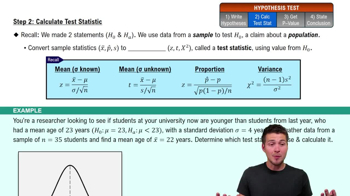
Step 2: Calculate Test Statistic

Sample Variance

Sample variance is a measure of the dispersion of a set of sample data points around their mean. It is calculated by taking the average of the squared differences from the mean. In the context of the F test, the larger sample variance (s²,1) is compared to the smaller one to assess the equality of variances.
Recommended video:
05:11
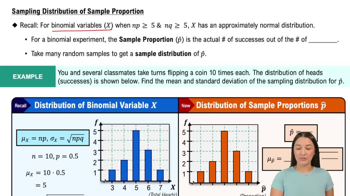
Sampling Distribution of Sample Proportion

Interpretation of F Statistic Values

The F statistic can take values greater than or equal to 1, as it is a ratio of variances. If the larger variance is divided by the smaller variance, the result will always be 1 or more. Therefore, the F test statistic cannot be less than 1, as it would imply that the larger variance is smaller than the smaller variance, which is a contradiction.
Recommended video:
Guided course
05:53
Parameters vs. Statistics
Related Practice
Textbook Question

Forecast and Actual Temperatures Listed below are actual temperatures (°F) along with the temperatures that were forecast five days earlier (data collected by the author). Use a 0.05 significance level to test the claim that differences between actual temperatures and temperatures forecast five days earlier are from a population with a mean of 0°F.

Textbook Question

In Exercises 5–16, use the listed paired sample data, and assume that the samples are simple random samples and that the differences have a distribution that is approximately normal.


The Freshman 15 The “Freshman 15” refers to the belief that college students gain 15 lb (or 6.8 kg) during their freshman year. Listed below are weights (kg) of randomly selected male college freshmen (from Data Set 13 “Freshman 15” in Appendix B). The weights were measured in September and later in April.


a. Use a 0.01 significance level to test the claim that for the population of freshman male college students, the weights in September are less than the weights in the following April.

Textbook Question

Variation of Hospital Times Use the sample data given in Exercise 7 “Seat Belts” and test the claim that for children hospitalized after motor vehicle crashes, the numbers of days in intensive care units for those wearing seat belts and for those not wearing seat belts have the same variation. Use a 0.05 significance level.

Textbook Question

Pulse Rates of Women and Men Using the samples of women and men included in Data Set 1 “Body Data,” we get this 95% confidence interval estimate of the difference between the population mean of pulse rates (bpm) of women and the population mean of pulse rates (bpm) of men: 1.7 bpm < u1-u2 < 7.2bpm. In this confidence interval, women correspond to population 1 and men correspond to population 2.


a. What does the confidence interval suggest about equality of the mean pulse rate of women and the mean pulse rate of men?

Textbook Question

Friday the 13th Refer to the sample data from Exercise 1.


a. Find the differences d, then find the values of d_bar and sd

Textbook Question

In Exercises 5–20, assume that the two samples are independent simple random samples selected from normally distributed populations, and do not assume that the population standard deviations are equal. (Note: Answers in Appendix D include technology answers based on Formula 9-1 along with “Table” answers based on Table A-3 with df equal to the smaller of n1-1 and n2-1)


Color and Cognition Researchers from the University of British Columbia conducted a study to investigate the effects of color on cognitive tasks. Words were displayed on a computer screen with background colors of red and blue. Results from scores on a test of word recall are given below. Higher scores correspond to greater word recall.


a. Use a 0.05 significance level to test the claim that the samples are from populations with the same mean.


" style="" width="440">