Skip to main content
Sociology
My Course
Learn
AI Tutor
Study Guides
Flashcards
Explore
Try the app
My Course
Learn
AI Tutor
Study Guides
Flashcards
Explore
Try the app
Back
Types of Schools and School Choice definitions
You can tap to flip the card.
Public Schools
You can tap to flip the card.
👆
Public Schools
Government-operated institutions offering free education, following state curriculums, and serving students within specific districts.
Track progress
Control buttons has been changed to "navigation" mode.
1/28
Related flashcards
Recommended videos
Types of Schools and School Choice quiz
Types of Schools and School Choice
15 Terms
Guided course
01:10
Types of Schools and School Choice Example 1
1
views
Guided course
06:53
Types of Schools and School Choice
1
views
Terms in this set (28)
Hide definitions
Public Schools
Government-operated institutions offering free education, following state curriculums, and serving students within specific districts.
Magnet Schools
Specialized public institutions providing focused programs in areas like engineering, arts, or mathematics, often requiring applications or lotteries.
Charter Schools
Public institutions operating under performance contracts, allowing experimentation with new policies and programs, with accountability for results.
Private Schools
Institutions funded by tuition and private sources, offering greater flexibility, smaller class sizes, and selective admissions.
Religious Private Schools
Privately funded institutions affiliated with religious organizations, integrating moral or religious values into their educational approach.
School Choice
Policy framework enabling families to select educational institutions beyond their local district, using public funds or vouchers.
Vouchers
Publicly funded certificates allowing families to pay for education at schools of their choice, including private and religious institutions.
Educational Marketplace
Competitive environment where schools vie for students, theoretically raising standards and improving quality through choice.
State Curriculum
Standardized educational guidelines mandated by state authorities, shaping instruction in public institutions.
District
Geographically defined area determining eligibility for enrollment in local public institutions.
Tuition
Monetary payment required for enrollment in privately funded educational institutions.
Accessibility Services
Support mechanisms for students with special needs, often mandated in public institutions but not guaranteed in private settings.
Class Size
Number of students assigned to a single classroom, influencing personalization and resource allocation.
Performance Contract
Agreement outlining goals and accountability measures for charter institutions, enabling policy experimentation.
Cultural Capital
Non-financial assets, such as education and social skills, aiding families in navigating school selection processes.
Competition
Dynamic among institutions striving to attract students, posited to drive improvement and raise standards.
Inequality
Disparities in access, resources, or outcomes among students, potentially exacerbated by school selection policies.
Separation of Church and State
Principle restricting government involvement in religious activities, debated in the context of funding religious education.
Taxpayer Money
Public funds collected from citizens, used to finance educational institutions and school selection programs.
Underperforming District
Area where public institutions consistently yield lower academic outcomes, often targeted by school selection policies.
Educational Quality
Measure of effectiveness, resources, and outcomes within institutions, central to debates on school selection.
Stratification
Layering of students or families based on socioeconomic status or race, potentially intensified by school selection.
Supreme Court
Judicial body determining constitutionality of policies, including those related to school selection and funding.
Accountability
Obligation of institutions to demonstrate effectiveness and meet standards, more pronounced in public and charter settings.
Flexibility
Capacity for institutions to adapt programs and policies, often greater in private and charter settings.
Personalization
Tailoring of educational experiences to individual student needs, more prevalent in private institutions.
Lottery
Randomized selection process used by magnet and charter institutions when demand exceeds available spaces.
Resources
Materials, funding, and support available to institutions, influencing educational outcomes and opportunities.
 BackBack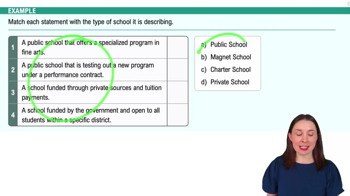
 01:10
01:10