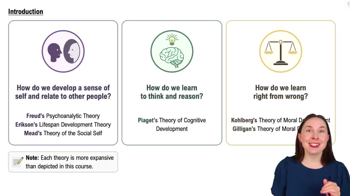
What are the three components of personality according to Freud's psychoanalytic theory?
Freud's theory includes the id (primitive desires), the superego (societal values and norms), and the ego (rational mediator between id and superego).
At what age does Freud believe the superego begins to develop, and what does it represent?
The superego begins developing around age five and represents the internalization of societal values and norms, acting as a moral compass.
What is the main function of the ego in Freud's theory?
The ego mediates between the id's desires and the superego's expectations, finding a balance for acceptable behavior.
What is sublimation in Freud's psychoanalytic theory?
Sublimation is the process of redirecting impulse drives from the id into socially acceptable behaviors, as managed by the ego.
What is the central question of Erikson's first stage of development, and why is it important?
The central question is 'Can I trust others to meet my needs?' and it lays the foundation for future social relationships.
How does Erikson's theory differ from other developmental theories?
Erikson's theory covers development across the entire lifespan, emphasizing social challenges at each stage from infancy to late adulthood.
According to Mead, how does the 'self' develop?
Mead believed the self develops gradually through social experiences and interactions, not present at birth.
What are the 'I' and 'me' components in Mead's theory of the social self?
The 'I' is the spontaneous, impulsive aspect of self, while the 'me' reflects on actions based on societal norms and expectations.
What is the significance of role-taking in Mead's theory?
Role-taking, or perspective-taking, is essential for developing the self, as it helps individuals understand themselves through the eyes of others.
What are the three stages of self-development according to Mead?
The stages are imitation (birth-3 years), play (3-6 years), and game (7-9 years), each involving increasing ability to take the perspective of others.
What is the 'generalized other' in Mead's theory?
The 'generalized other' refers to the understanding of societal norms and values that apply across multiple social contexts.
What are Piaget's four stages of cognitive development?
The stages are sensorimotor (birth-2), preoperational (2-7), concrete operational (7-11), and formal operational (12+), each with distinct cognitive abilities.
How does moral reasoning change across Kohlberg's three stages of moral development?
Moral reasoning shifts from focusing on personal consequences (preconventional), to social rules (conventional), to abstract principles and ethics (postconventional).
What was Gilligan's main criticism of Kohlberg's theory of moral development?
Gilligan argued that Kohlberg's theory was gender-biased, as it was based only on male participants and did not account for different moral reasoning styles socialized in women.
How does Gilligan distinguish between the justice and care perspectives in moral reasoning?
The justice perspective, used more by men, emphasizes rules and fairness, while the care perspective, used more by women, focuses on relationships, empathy, and context.
 Back
Back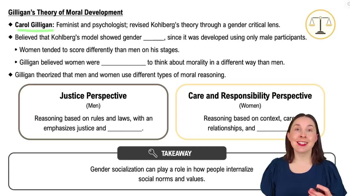
 02:41
02:41