Skip to main content
Sociology
My Course
Learn
AI Tutor
Study Guides
Flashcards
Explore
Try the app
My Course
Learn
AI Tutor
Study Guides
Flashcards
Explore
Try the app
Back
Theories of Socialization definitions
You can tap to flip the card.
Socialization
You can tap to flip the card.
👆
Socialization
Process through which individuals develop identity, values, and skills by interacting with others and society.
Track progress
Control buttons has been changed to "navigation" mode.
1/16
Related flashcards
Recommended videos
Theories of Socialization quiz
Theories of Socialization
15 Terms
Guided course
02:41
Gilligan's Theory of Moral Development
1
views
Guided course
01:15
Theories of Socialization Example 4
Guided course
01:28
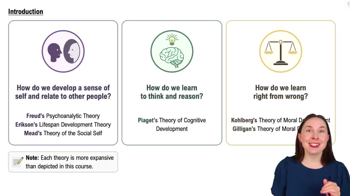
Introduction
1
views
Terms in this set (16)
Hide definitions
Socialization
Process through which individuals develop identity, values, and skills by interacting with others and society.
Id
Source of instinctual drives seeking immediate gratification and pleasure, present from birth and unconcerned with societal rules.
Ego
Mediator balancing instinctual desires and societal expectations, enabling rational decision-making and impulse control.
Superego
Internalized set of societal norms and values acting as a moral compass, producing feelings like guilt or shame.
Sublimation
Redirection of instinctual impulses into socially acceptable behaviors, helping align personal drives with cultural norms.
Lifespan Development
Perspective emphasizing that growth and social challenges continue from infancy through late adulthood.
Role Taking
Ability to adopt another person's perspective, essential for understanding social expectations and developing self-awareness.
Generalized Other
Awareness of broader societal norms and values that guide behavior across various social contexts.
Egocentrism
Tendency, especially in early childhood, to struggle with understanding viewpoints different from one's own.
Concrete Operational Stage
Developmental period where logical thinking about tangible objects emerges, but abstract reasoning remains limited.
Formal Operational Stage
Phase marked by the ability to reason about abstract concepts, hypothetical situations, and future possibilities.
Preconventional Stage
Moral reasoning focused on personal consequences, such as avoiding punishment or seeking rewards.
Conventional Stage
Moral reasoning centered on conforming to social expectations, rules, and maintaining order.
Postconventional Stage
Moral reasoning based on abstract principles, ethics, and recognition that laws may not always be just.
Justice Perspective
Approach to morality emphasizing rules, fairness, and equality, often associated with male socialization.
Care Perspective
Approach to morality prioritizing relationships, empathy, and context, often linked to female socialization.
 BackBack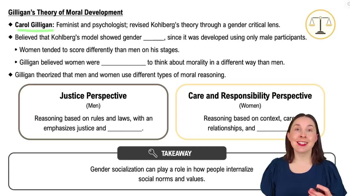
 02:41
02:41