How does the functionalist perspective view illness in society?
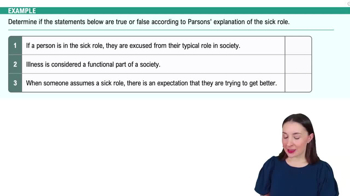
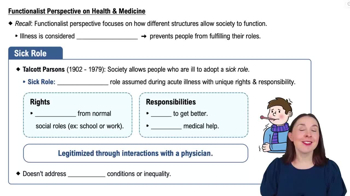
The functionalist perspective sees illness as a dysfunction that prevents people from fulfilling their roles, which disrupts societal stability and order.
What is the 'sick role' according to Talcott Parsons?
The 'sick role' is a temporary social role that grants ill individuals the right to be excused from normal responsibilities, but also expects them to try to recover and seek medical help.
What are the two main expectations of someone adopting the sick role?
They are expected to try to get better and to seek medical help if needed.
Why has the sick role theory been criticized?
It fails to address chronic health conditions and does not consider social inequalities that may prevent some people from adopting the sick role.
How does the conflict perspective explain healthcare inequality?
The conflict perspective argues that capitalism and socioeconomic status influence healthcare access, leading to inequalities based on wealth, power, race, and gender.
What is meant by the 'commodification of healthcare'?
It refers to treating healthcare as a product to be bought and sold, rather than as a public good or human right.
How does the profit motive in healthcare affect medical practice, according to conflict theorists?
It incentivizes doctors to prescribe more medications or perform more procedures to generate profit, rather than focusing solely on patient well-being.
What are social determinants of health, and why are they important in the conflict perspective?
Social determinants of health are broader social factors like poverty or living in a food desert that affect health; conflict theorists argue these must be addressed to reduce health inequalities.
How has medicine historically contributed to gender inequality?
Medicine has perpetuated gender inequality through diagnoses like 'hysteria,' which was used to pathologize women's behavior without biological basis.
What is an example of racial disparity in medical training and care?
Historically, doctors were not trained to recognize skin conditions on people of color, leading to misdiagnosis and inadequate care.
What does the symbolic interactionist perspective focus on in health and medicine?
It focuses on how social interactions and subjective experiences shape the meanings of illness and treatment.
How does stigma relate to illness in the symbolic interactionist approach?
Stigma can affect how individuals with certain illnesses are treated by others, influencing their social experience and self-perception.
What is meant by the 'social construction of treatment'?
It refers to how medical treatment is defined and shaped by social meanings, roles, and interactions between patients and healthcare providers.
How does Erving Goffman's dramaturgical approach apply to medical settings?
Medical interactions are seen as social performances, with doctors and patients adopting specific roles, using props, and following scripts to create a professional and safe environment.
Why is the medical setting considered a unique social situation according to symbolic interactionists?
Because behaviors like physical examination, which would be inappropriate elsewhere, are made acceptable through the structured roles and norms of the medical environment.
 Back
Back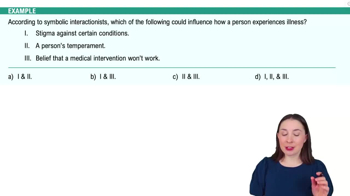
 00:54
00:54