Skip to main content
Sociology
My Course
Learn
AI Tutor
Study Guides
Flashcards
Explore
Try the app
My Course
Learn
AI Tutor
Study Guides
Flashcards
Explore
Try the app
Back
Theoretical Perspectives on Health and Medicine definitions
You can tap to flip the card.
Functionalist Perspective
You can tap to flip the card.
👆
Functionalist Perspective
A view that sees illness as a disruption to societal stability, emphasizing the role of health systems in maintaining social order.
Track progress
Control buttons has been changed to "navigation" mode.
1/15
Related flashcards
Recommended videos
Theoretical Perspectives on Health and Medicine quiz
Theoretical Perspectives on Health and Medicine
15 Terms
Guided course
00:54
Theoretical Perspectives on Health and Medicine Example 3
1
views
Guided course
01:01
Theoretical Perspectives on Health and Medicine Example 1
1
views
Guided course
02:55
Functionalist Perspective on Health & Medicine
1
views
Terms in this set (15)
Hide definitions
Functionalist Perspective
A view that sees illness as a disruption to societal stability, emphasizing the role of health systems in maintaining social order.
Sick Role
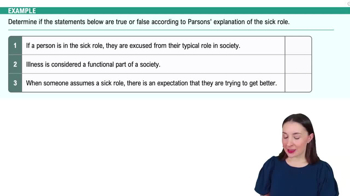
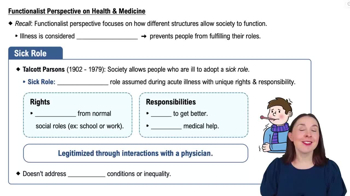
A temporary status granting unique rights and responsibilities, legitimized by society, for those experiencing acute illness.
Dysfunction
A condition or event that prevents individuals from fulfilling expected social roles, threatening societal stability.
Conflict Perspective
A framework focusing on how social structures, especially capitalism, create and perpetuate health inequalities.
Commodification
The process of treating healthcare as a product for sale, rather than as a public good or basic human right.
Socioeconomic Status
A measure of an individual's or group's economic and social position, influencing access to healthcare resources.
Profit Motive
An incentive within healthcare systems to prioritize financial gain, often influencing medical decisions and practices.
Social Determinants of Health
Non-medical factors like income, environment, and education that significantly impact health outcomes and disparities.
Racial Disparities
Systematic differences in healthcare access, treatment, or outcomes based on race, often rooted in historical biases.
Gender Disparities
Inequities in medical treatment or diagnosis based on gender, often perpetuated by historical and social biases.
Symbolic Interactionist Perspective
An approach emphasizing how health and illness are shaped by social interactions and subjective meanings.
Social Construction of Illness
The process by which society defines and interprets health conditions based on cultural beliefs and interactions.
Stigma
A negative social label attached to certain illnesses, influencing how individuals are perceived and treated.
Dramaturgical Approach
A concept viewing medical encounters as social performances, with roles, scripts, and settings shaping interactions.
Medicalization
The process by which non-medical issues are defined and treated as medical problems, often influenced by social factors.
 BackBack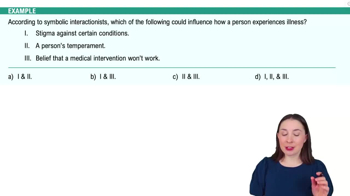
 00:54
00:54