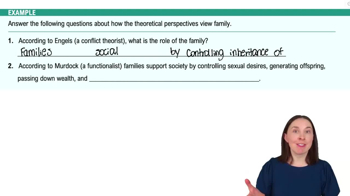
What are the four main functions of the family according to the functionalist perspective?
The four main functions are regulating sexual behavior, socializing children, reproduction, and transferring economic status.
Which theorist is associated with identifying the main functions of the family in the functionalist perspective?
George Murdoch is the theorist who identified the main functions of the family.
How does the functionalist perspective view the role of the family in society?
It sees the family as maintaining order and stability in society by fulfilling key functions.
According to conflict theory, how does the family perpetuate social inequality?
The family perpetuates inequality by passing down wealth and resources, often favoring males, which maintains class and gender hierarchies.
What historical change did Frederick Engels link to the rise of the nuclear family?
Engels linked the rise of the nuclear family to the rise of capitalism and industrialization.
How did the shift to nuclear families relate to economic changes during industrialization?
With economic growth and smaller homes, families no longer needed multiple adults to sustain themselves, leading to smaller, nuclear families.
How does the conflict perspective explain the transmission of social class through families?
It argues that families control inheritance, allowing the upper class to maintain and increase their wealth across generations.
What does the feminist perspective emphasize about power dynamics within families?
It emphasizes that those with more resources, typically men, have more power in relationships, reinforcing gender inequality.
How does unpaid labor contribute to gender inequality according to feminist theory?
Women often perform more unpaid labor, which limits their career advancement and earning potential, perpetuating male economic dominance.
What is the symbolic interactionist view of the family?
Symbolic interactionism sees the family as a social construct shaped by roles, language, and daily interactions.
How do symbolic interactionists explain changes in family roles over time?
They argue that family roles and expectations change across generations and cultures, reflecting the socially constructed nature of family.
How does language use reflect cultural differences in defining family according to symbolic interactionism?
Different cultures may use family terms like 'aunt' or 'cousin' for both relatives and close non-relatives, showing that language shapes family definitions.
What questions might symbolic interactionists ask about family authority?
They might ask who has authority in the family, how it is established, and how it is maintained through interactions.
How do symbolic interactionists view the assignment of family roles such as breadwinner or caregiver?
They see these roles as either assumed based on tradition or negotiated through social interaction.
Why do symbolic interactionists focus on everyday interactions within families?
Because they believe that family realities are created and maintained through daily social interactions and shared meanings.
 Back
Back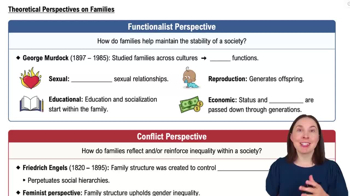
 07:02
07:02