Skip to main content
Sociology
My Course
Learn
AI Tutor
Study Guides
Flashcards
Explore
Try the app
My Course
Learn
AI Tutor
Study Guides
Flashcards
Explore
Try the app
Back
Theoretical Perspectives on Family definitions
You can tap to flip the card.
Functionalist Perspective
You can tap to flip the card.
👆
Functionalist Perspective
A view emphasizing how family maintains social order by regulating behavior, socializing members, reproducing society, and transferring status.
Track progress
Control buttons has been changed to "navigation" mode.
1/15
Related flashcards
Recommended videos
Theoretical Perspectives on Family quiz
Theoretical Perspectives on Family
15 Terms
Guided course
07:02
Theoretical Perspectives on Families
1
views
Guided course
01:42
Theoretical Perspectives on Family Example 1
1
views
Terms in this set (15)
Hide definitions
Functionalist Perspective
A view emphasizing how family maintains social order by regulating behavior, socializing members, reproducing society, and transferring status.
Conflict Theory
A framework focusing on how family structures reinforce class and gender inequalities, especially through inheritance and resource control.
Feminist Perspective
An approach highlighting unpaid labor and power imbalances within families, often resulting in gender inequality.
Symbolic Interactionism
A theory examining how family is constructed and experienced through roles, language, and everyday interactions.
Nuclear Family
A household unit consisting of parents and their children, often linked to capitalist societies and inheritance control.
Socialization
The process by which family members learn social norms, values, and expected behaviors, shaping their roles in society.
Inheritance
The transfer of wealth, assets, or status from one generation to the next, often perpetuating social hierarchies.
Gender Inequality
A disparity in power, resources, or status between men and women, often maintained within family structures.
Unpaid Labor
Domestic or caregiving work performed without financial compensation, disproportionately carried out by women.
Social Construct
A concept or practice that exists because people collectively agree to give it meaning, such as the idea of family.
Authority
The recognized power or right to make decisions within the family, which can be established or negotiated.
Social Stratification
A system by which society ranks individuals or groups, often reinforced by family through resource transmission.
Monogamy
A socially accepted partnership involving exclusive sexual relationships, often regulated by family norms.
Economic Status
A position within society based on wealth and resources, frequently passed down through family ties.
Roles
Expected patterns of behavior assigned to family members, which can change across cultures and generations.
 BackBack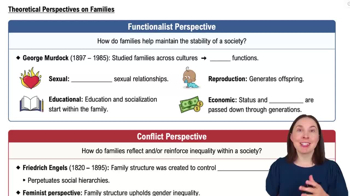
 07:02
07:02