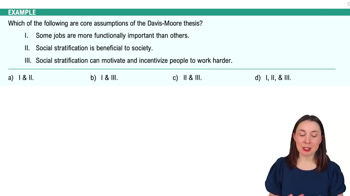
What is the main idea of the Davis-Moore thesis in the functionalist perspective on stratification?
The Davis-Moore thesis argues that social stratification benefits society by rewarding important jobs with greater rewards, thereby incentivizing hard work and talent.
According to functionalists, why are some jobs rewarded more than others?
Jobs that are considered more functionally important or culturally valuable are given more rewards such as income, prestige, and power.
What is a major criticism of the functionalist perspective on stratification?
A major criticism is that unequal rewards do not always accurately reflect the true contribution of a job to society and may be influenced by cultural biases.
How does the functionalist perspective view the relationship between inequality and motivation?
It suggests that some degree of inequality, when paired with social mobility, can motivate people to work harder and strive for higher positions.
What negative psychological effect can occur when there is high inequality and low social mobility, according to research?
People may become demotivated and experience learned helplessness, rather than being motivated to work harder.
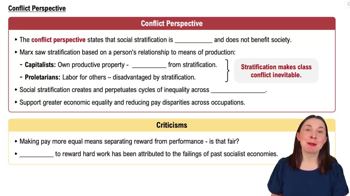
How does the conflict theory, rooted in Marxism, view social stratification?
Conflict theory sees stratification as harmful, perpetuating class conflict and benefiting the capitalist class at the expense of the proletariat.
What role does the transfer of wealth play in the conflict theory perspective?
Wealth is passed down through generations among the capitalist class, perpetuating cycles of inequality and maintaining class divides.
According to conflict theorists, what is a potential downside of reducing pay disparities across occupations?
Some argue that making pay more equal separates reward from performance, which may be seen as unfair to those who invest more time and effort in their careers.
What historical example is used to criticize the conflict theory’s approach to rewards?
The failure to reward hard work is cited as a reason for the failings of past socialist economies, such as the former Soviet Union.
What is the focus of the symbolic interactionist perspective on stratification?
It focuses on the micro-level effects of stratification, such as how it shapes daily interactions, thoughts, and behaviors.
What is class-based segregation, according to symbolic interactionists?
Class-based segregation refers to the tendency for people to interact mainly with others of similar social standing, often due to societal structure and personal biases.
What is conspicuous consumption and how does it relate to stratification?
Conspicuous consumption is when people purchase goods to signal their social status to others, reflecting the influence of stratification on behavior.
What is a major criticism of the symbolic interactionist perspective on stratification?
A major criticism is that it does not address the broader, structural causes of inequality, focusing instead on individual-level effects.
How do symbolic interactionists view the fairness of stratification?
They argue that perceptions of fairness depend on individual experiences and beliefs, which in turn shape thoughts and behaviors about social class.
How do the three theoretical perspectives differ in their view of whether stratification is fair?
Functionalists generally see it as fair and beneficial, conflict theorists see it as unfair and harmful, and symbolic interactionists believe fairness depends on individual perception.
 Back
Back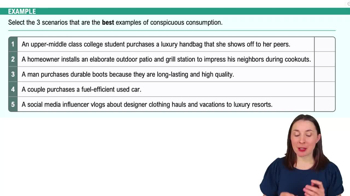
 01:30
01:30