Skip to main content
Sociology
My Course
Learn
AI Tutor
Study Guides
Flashcards
Explore
Try the app
My Course
Learn
AI Tutor
Study Guides
Flashcards
Explore
Try the app
Back
Theoretical Perspectives of Stratification definitions
You can tap to flip the card.
Social Stratification
You can tap to flip the card.
👆
Social Stratification
A hierarchical arrangement of individuals in society based on socioeconomic factors, shaping access to rewards and resources.
Track progress
Control buttons has been changed to "navigation" mode.
1/29
Related flashcards
Recommended videos
Theoretical Perspectives of Stratification quiz
Theoretical Perspectives of Stratification
15 Terms
Guided course
01:30
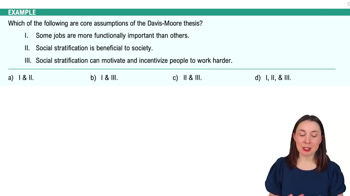
Theoretical Perspectives of Stratification Example 3
Guided course
03:02
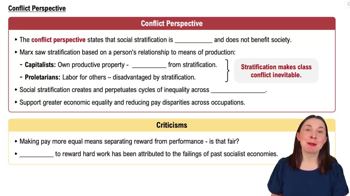
Conflict Perspective
1
views
Guided course
01:03
Theoretical Perspectives of Stratification Example 1
1
views
Terms in this set (29)
Hide definitions
Social Stratification
A hierarchical arrangement of individuals in society based on socioeconomic factors, shaping access to rewards and resources.
Functionalist Perspective
A viewpoint emphasizing societal benefits from unequal rewards linked to job importance and cultural value.
Davis–Moore Thesis
A theory proposing that unequal rewards motivate individuals to pursue jobs deemed more valuable or important.
Occupational Prestige
A measure of cultural value and respect assigned to specific jobs within a society.
Social Power
The capacity to influence others and access resources due to one's position in the social hierarchy.
Economic Inequality
A disparity in income, wealth, and access to resources among different social groups.
Social Mobility
The ability for individuals or groups to move between different social strata or classes.
Conflict Theory
A perspective highlighting the harmful effects of stratification, focusing on class divisions and power imbalances.
Marxist Political-Economy Model
An approach analyzing society through class relations, productive property, and economic power.
Capitalist Class
A group owning productive property, accumulating wealth, power, and prestige through stratification.
Proletarian Class
A group laboring for others, lacking ownership of productive property and facing disadvantages in stratification.
Class Conflict
A struggle between social groups over access to resources, power, and rewards, often perpetuated by stratification.
Intergenerational Wealth Transfer
The passing of accumulated assets and advantages from one generation to the next, reinforcing class divisions.
Pay Disparities
Differences in compensation across occupations, often reflecting social and economic inequalities.
Symbolic Interactionism
A micro-level perspective focusing on daily social interactions shaped by socioeconomic status.
Class-Based Segregation
The separation of individuals into distinct neighborhoods or communities based on social class.
Conspicuous Consumption
The purchase of goods to signal social standing or wealth to others, often for status display.
Class-Based Prejudice
Negative attitudes or biases directed toward individuals from different social classes.
Counterculture
A group deliberately opposing mainstream values, sometimes signaling lower social standing through consumption.
Socioeconomic Status
A composite measure of an individual's economic and social position relative to others.
Cultural Bias
A tendency to value certain jobs or groups over others based on societal norms and prejudices.
Learned Helplessness
A psychological state where individuals feel powerless to change their social position due to persistent inequality.
Social Identity
A sense of self shaped by one's social class and perceived position within the social hierarchy.
Social Ladder
A metaphor for the hierarchical structure of society, representing opportunities for upward mobility.
Reward System
A structure linking compensation and benefits to perceived job importance and performance.
Cultural Assessment
Societal evaluation of job value, often influenced by biases and stereotypes.
Social Inequality
Unequal distribution of resources, opportunities, and privileges among individuals or groups.
Micro-Level Approach
An analytical focus on individual interactions and daily experiences within the context of stratification.
Macro-Level Approach
An analytical focus on broad societal patterns and structures influencing stratification.
 BackBack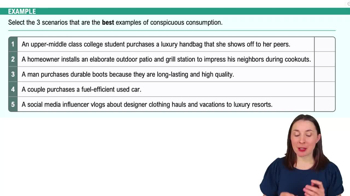
 01:30
01:30