What is the primary factor used to stratify the U.S. class system in this lesson?
Income is the primary factor used to stratify the U.S. class system in this lesson.
How is the upper class in the U.S. divided, and what distinguishes these groups?
The upper class is divided into 'old money' (inherited wealth) and 'new money' (recently earned wealth).
What are some typical characteristics of the U.S. middle class?
The middle class often has white-collar jobs, higher education, home ownership, and some savings, but must keep working to maintain their lifestyle.
What type of jobs and financial stability are associated with the working class?
The working class is associated with blue-collar jobs, less education, little savings, and less stable access to necessities like healthcare.
What challenges do people in the lower class typically face?
People in the lower class often have low-wage work or unemployment, struggle to afford basic needs, and have little education or savings.
What are class traits (or class markers), and why are they important?
Class traits are behaviors, customs, and norms common within each social class, such as housing, dress, and vocabulary, which influence social perceptions.
What is social mobility, and in what type of social hierarchy is it most common?
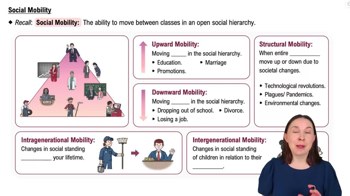
Social mobility is the ability to move between social classes and is most common in open social hierarchies.
What is the difference between upward and downward social mobility?
Upward mobility is moving up in the social hierarchy (e.g., through education or marriage), while downward mobility is moving down (e.g., due to job loss or divorce).
What is structural mobility, and what can cause it?
Structural mobility refers to entire groups moving up or down due to societal changes, such as economic booms or natural disasters.
How do intragenerational and intergenerational mobility differ?
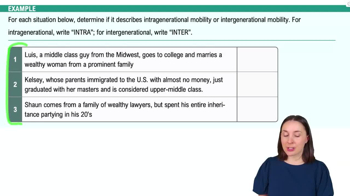
Intragenerational mobility is a change in social standing within a person's lifetime, while intergenerational mobility is a change between parents and their children.
How is poverty defined in sociology, and what are basic standards of living?
Poverty is lacking resources to meet basic standards of living, which include housing, healthcare, food, and education.
What is the difference between absolute and relative poverty?
Absolute poverty is lacking resources for basic survival, while relative poverty is having less than 50% of the median income compared to others in society.
What is the feminization of poverty, and what are two main causes?
The feminization of poverty refers to women experiencing poverty at higher rates than men, mainly due to the pay gap and women heading single-parent households.
What is the federal poverty level, and how is it used?
The federal poverty level is an income threshold used to determine eligibility for government assistance, based on the cost of living in the U.S.
How do individualistic and structural explanations of poverty differ?
Individualistic explanations focus on personal responsibility and attitudes, while structural explanations emphasize societal barriers and unequal opportunities.
 Back
Back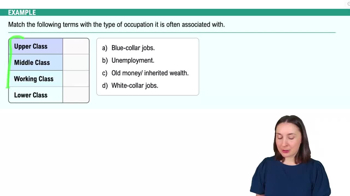
 00:53
00:53