Skip to main content
Sociology
My Course
Learn
AI Tutor
Study Guides
Flashcards
Explore
Try the app
My Course
Learn
AI Tutor
Study Guides
Flashcards
Explore
Try the app
Back
Social Stratification in the U.S. definitions
You can tap to flip the card.
Upper Class
You can tap to flip the card.
👆
Upper Class
A small segment of society often distinguished by inherited or newly acquired wealth, significant influence, and control over major institutions.
Track progress
Control buttons has been changed to "navigation" mode.
1/16
Related flashcards
Recommended videos
Social Stratification in the U.S. quiz
Social Stratification in the U.S.
15 Terms
Guided course
00:53
Social Stratification in the U.S. Example 1
1
views
Guided course
03:22
Social Mobility
1
views
Guided course
01:26
Social Stratification in the U.S. Example 2
1
views
Terms in this set (16)
Hide definitions
Upper Class
A small segment of society often distinguished by inherited or newly acquired wealth, significant influence, and control over major institutions.
Middle Class
The largest social group, typically associated with white collar employment, home ownership, higher education, and financial stability.
Working Class
A group primarily engaged in blue collar jobs, often with limited savings, lower educational attainment, and less stable access to benefits.
Lower Class
A segment facing low-wage work or unemployment, struggling to afford basic needs, with minimal savings and limited educational opportunities.
Class Traits
Behaviors, customs, and norms—such as housing, dress, and language—that signal social standing and influence perceptions.
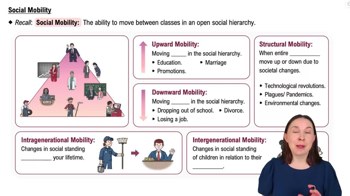
Social Mobility
The capacity for individuals or groups to shift between social classes within an open hierarchy.
Upward Mobility
A rise in social standing, often achieved through education, career advancement, or marriage into a higher class.
Downward Mobility
A decline in social status, commonly resulting from job loss, reduced income, or family changes like divorce.
Structural Mobility
A collective shift in social position caused by broad societal changes, such as economic booms or disasters.
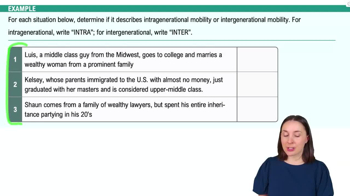
Intragenerational Mobility
A change in an individual's social status occurring within their own lifetime.
Intergenerational Mobility
A shift in social standing observed between parents and their children across generations.
Absolute Poverty
A condition where resources are insufficient to meet basic living standards, measured by fixed thresholds like the federal poverty level.
Relative Poverty
A state where individuals lack resources compared to others in their society, often defined as earning less than half the median income.
Feminization of Poverty
A trend where women experience poverty at higher rates than men, influenced by wage gaps and single-parent responsibilities.
Individualistic Explanation
A perspective attributing poverty to personal choices, values, and attitudes, emphasizing individual responsibility.
Structural Explanation
A viewpoint focusing on societal barriers, such as job scarcity and unequal opportunities, as root causes of poverty.
 BackBack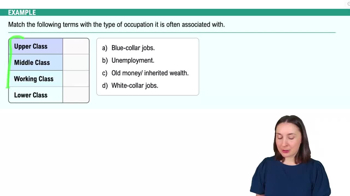
 00:53
00:53