Skip to main content
Sociology
My Course
Learn
AI Tutor
Study Guides
Flashcards
Explore
Try the app
My Course
Learn
AI Tutor
Study Guides
Flashcards
Explore
Try the app
Back
History of Sociology quiz
You can tap to flip the card.
In what century and region did sociology first emerge as a distinct discipline?
You can tap to flip the card.
👆
In what century and region did sociology first emerge as a distinct discipline?
Sociology emerged in 19th-century Europe.
Track progress
Control buttons has been changed to "navigation" mode.
1/15
Related flashcards
Recommended videos
History of Sociology definitions
History of Sociology
15 Terms
Guided course
04:25
History of Sociology
Guided course
00:48
Example 1
2
views
Terms in this set (15)
Hide definitions
In what century and region did sociology first emerge as a distinct discipline?
Sociology emerged in 19th-century Europe.
What major economic transformation contributed to the rise of sociology?
The Industrial Revolution contributed to the rise of sociology by changing work patterns and increasing economic inequality.
How did urbanization during the 19th century affect European society?
Urbanization led to people moving into cities, which caused increased social problems like disease, pollution, crime, and homelessness.
What happened to traditional community bonds during the rise of industrial society?
Traditional community bonds declined as people spent more time working in factories and less time in their communities.
What political changes were occurring in Europe during the emergence of sociology?
There was a decline in the belief in the divine right of kings and a rise in ideas about self-interest, personal liberty, and individual rights.
Who is considered the first official sociologist?
Auguste Comte, a French philosopher, is considered the first official sociologist.
What is positivism, as introduced by Auguste Comte?
Positivism is the scientific study of social patterns based on facts rather than philosophical speculation.
How did Comte’s approach to studying society differ from earlier philosophers?
Comte wanted to scientifically study how societies actually work, rather than just speculating about or trying to improve them.
What did Comte mean by 'social physics'?
Comte believed that societies operate according to laws similar to those in physics, and he called his study 'social physics.'
What are the three stages in Comte’s law of three stages?
The three stages are the theological stage, the metaphysical stage, and the scientific stage.
How did society view itself during the theological stage, according to Comte?
During the theological stage, society was viewed as an expression of God's will.
What characterized the metaphysical stage in Comte’s theory?
In the metaphysical stage, society was seen as a product of human nature, influenced by philosophers like Locke, Rousseau, and Hobbes.
What marks the scientific stage in Comte’s law of three stages?
The scientific stage is marked by a scientific approach to understanding society, influenced by thinkers like Copernicus, Newton, and Galileo.
Why is Comte considered revolutionary in the history of sociology?
Comte was the first to propose studying society scientifically, moving away from speculation and focusing on empirical evidence.
What is one limitation of Comte’s idea that society operates according to fixed laws?
Human interactions and society are more dynamic and complex than can be explained by fixed laws like those in physics or chemistry.
 BackBack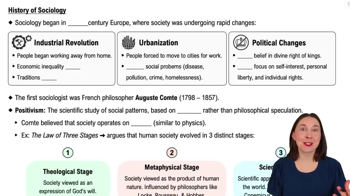
 04:25
04:25