Skip to main content
Sociology
My Course
Learn
AI Tutor
Study Guides
Flashcards
Explore
Try the app
My Course
Learn
AI Tutor
Study Guides
Flashcards
Explore
Try the app
Back
History of Sociology definitions
You can tap to flip the card.
Industrial Revolution
You can tap to flip the card.
👆
Industrial Revolution
A period marked by a shift to factory work, leading to urban migration, economic inequality, and weakened traditional community bonds.
Track progress
Control buttons has been changed to "navigation" mode.
1/15
Related flashcards
Recommended videos
History of Sociology quiz
History of Sociology
15 Terms
Guided course
04:25
History of Sociology
Guided course
00:48
Example 1
2
views
Terms in this set (15)
Hide definitions
Industrial Revolution
A period marked by a shift to factory work, leading to urban migration, economic inequality, and weakened traditional community bonds.
Urbanization
The movement of populations into cities, resulting in increased social issues like disease, pollution, and crime.
Economic Inequality
A widening gap between wealthy and poor populations, intensified by industrial and social changes.
Social Problems
Challenges such as crime, homelessness, and pollution that escalated with rapid urban and industrial growth.
Political Change
Shifts in governance and ideology, including declining belief in monarchy and rising focus on individual rights.
Positivism
A scientific approach to studying society, emphasizing factual evidence over philosophical speculation.
Law of Three Stages
A theory describing societal evolution through theological, metaphysical, and scientific phases.
Theological Stage
A period when society was interpreted as reflecting divine will, dominant until the European Middle Ages.
Metaphysical Stage
A phase where society was seen as shaped by human nature, influenced by Enlightenment philosophers.
Scientific Stage
An era characterized by applying scientific reasoning to understand society, inspired by thinkers like Newton.
Social Structure
The organized patterns and relationships that shape how a society is arranged and functions.
Social Change
Transformations in societal organization, values, or norms, often triggered by industrial or political shifts.
Social Stratification
The hierarchical arrangement of individuals or groups in society, often based on wealth or status.
Empirical Evidence
Information gathered through observation or experimentation, foundational to the scientific study of society.
Social Physics
A concept likening societal laws to those of the natural sciences, aiming for systematic study of social patterns.
 BackBack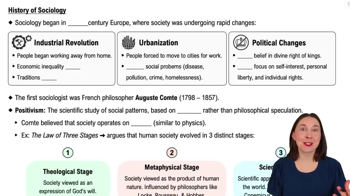
 04:25
04:25