Skip to main content
Sociology
My Course
Learn
AI Tutor
Study Guides
Flashcards
Explore
Try the app
My Course
Learn
AI Tutor
Study Guides
Flashcards
Explore
Try the app
Back
Health and Society quiz
You can tap to flip the card.
How do sociologists define health?
You can tap to flip the card.
👆
How do sociologists define health?
Health is defined as a state of physical, mental, and social well-being.
Track progress
Control buttons has been changed to "navigation" mode.
1/15
Related flashcards
Recommended videos
Health and Society definitions
Health and Society
15 Terms
Guided course
02:35
Health Across the Globe
2
views
Guided course
01:01
Health and Society Example 2
Guided course
00:38
Health and Society Example 1
1
views
Terms in this set (15)
Hide definitions
How do sociologists define health?
Health is defined as a state of physical, mental, and social well-being.
What does morbidity refer to in sociology?
Morbidity refers to the prevalence of a disease or illness within a population.
What does mortality measure?
Mortality measures the number of deaths from a disease or illness in a population.
How can social norms influence health?
Social norms can make certain unhealthy behaviors seem normal, leading people to continue them even if they are harmful.
How has medical knowledge changed over time?
Medical knowledge evolves, and practices once considered healthy, like prescribing cigarettes, are now known to be harmful.
What role does technology play in health?
Technology can improve health and quality of life but may also contribute to problems like sedentary lifestyles.
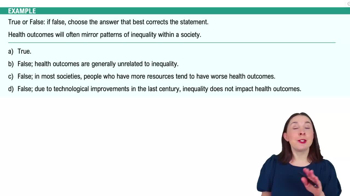
How does inequality affect health outcomes?
Inequality leads to differences in health outcomes across race, class, and gender, with higher socioeconomic status linked to better health.
What are some major health challenges in low-income countries?
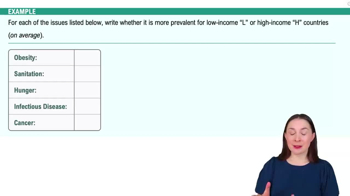
Low-income countries face issues like poor sanitation, hunger, infectious diseases, and high infant mortality.
How does poverty relate to disease in low-income countries?
Poverty is linked to diseases, with about one billion people annually suffering from poverty-associated illnesses.
What is the life expectancy difference between low and high-income countries?
Life expectancy in low-income countries is about twenty years less than in high-income countries.
What health issues are common in high-income countries?
High-income countries commonly face obesity, heart disease, diabetes, and higher rates of cancer.
Why might cancer rates be higher in high-income countries?
Cancer rates may be higher because people live longer, increasing the chance of a cancer diagnosis.
What is a notable trend in life expectancy in the United States compared to other high-income countries?
People in the United States have a lower life expectancy than those in other high-income nations.
How does access to healthcare differ between low and high-income countries?
High-income countries generally have better access to quality medical care than low-income countries.
What is the relationship between socioeconomic status and health?
Higher socioeconomic status is associated with better physical and mental health outcomes.
 BackBack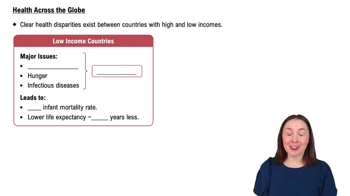
 02:35
02:35