What is the first step in the scientific method for sociological research?
The first step is to identify a problem or gap in knowledge, often by conducting a literature review to examine related research.
What is a hypothesis in sociological research?
A hypothesis is a statement that attempts to explain phenomena by specifying relationships among variables that can be empirically tested.
What are quantitative data in sociology?
Quantitative data are numerical observations used to understand relationships between variables, often analyzed using statistics.
How does qualitative research differ from quantitative research?
Qualitative research uses non-numerical data to understand how people interpret and experience their social world, focusing on themes and patterns.
What is a variable in sociological research?
A variable is a construct of interest that can vary from person to person or situation to situation, such as age, income, or education.
What is the difference between an independent variable and a dependent variable?
The independent variable is believed to influence or change another variable, while the dependent variable is measured and assumed to be affected by the independent variable.
Can independent variables in sociology always be manipulated?
No, in sociology independent variables can be manipulated or measured, especially when dealing with constructs like race or SES that cannot be changed.
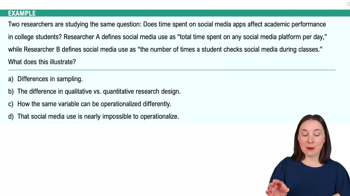
What is an operational definition?
An operational definition describes a variable in quantifiable or measurable terms, specifying exactly how it will be defined and measured in a study.
Why are operational definitions important in sociological research?
They clarify how abstract concepts are measured, impacting how results are interpreted and the validity of the study.
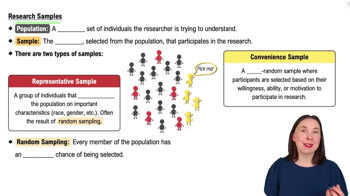
What is a population in sociological research?
A population is the large set of individuals that the researcher is trying to understand, such as all adolescents in the United States.
What is a sample and how is it selected?
A sample is the group selected from the population who actually participates in the research, chosen either randomly or by convenience.
What is a representative sample?
A representative sample matches the population on important characteristics and is often obtained through random sampling.
What is a convenience sample?
A convenience sample is a non-random sample where participants are selected based on their willingness or ability to participate, often used for practical reasons.
What is reliability in sociological research?
Reliability is the degree to which an assessment provides consistent scores across time and place, indicating stability of measurement.
What is validity and why is it important?
Validity is how well a study measures what it intends to measure; it is important because it ensures accurate and meaningful results that can be generalized.
 Back
Back
 01:22
01:22