A systematic approach for investigating social issues, involving problem identification, hypothesis creation, data analysis, and peer-reviewed publication.
Hypothesis
A testable statement predicting relationships among constructs, guiding empirical investigation in sociological studies.
Variable
A construct that can differ across individuals or situations, serving as a focus for measurement and analysis in research.
Independent Variable
A factor believed to influence or cause changes in another construct, often manipulated or measured in studies.
Dependent Variable
A measured outcome in research, assumed to be affected by another construct under investigation.
Quantitative Data
Numerical information collected to examine patterns, correlations, or causal relationships in social research.
Qualitative Data
Non-numerical information, such as text or images, used to explore meanings, experiences, or themes in social contexts.
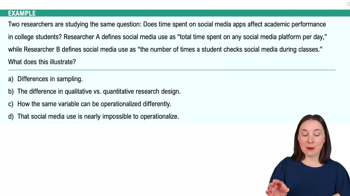
Operational Definition
A detailed description specifying how an abstract concept is measured or quantified in a particular study.
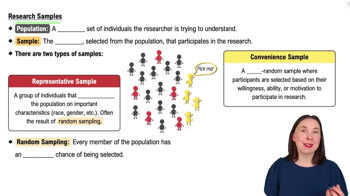
Population
The broad group of individuals a researcher aims to understand or draw conclusions about in a study.
Sample
A subset of individuals selected from a larger group to participate in research, representing the population.
Representative Sample
A group mirroring key characteristics of a larger population, enhancing the generalizability of findings.
Convenience Sample
A group chosen based on accessibility or willingness to participate, often used for practical reasons in studies.
Reliability
The consistency of a measurement tool, reflected in stable results across time, place, or repeated assessments.
Validity
The extent to which a study accurately measures the intended concept, ensuring meaningful and trustworthy results.
Generalizability
The degree to which research findings from a sample can be confidently applied to the broader population.
 Back
Back
 01:22
01:22