 Back
BackIdentifying Irrational Numbers in a Set
Study Guide - Smart Notes
 Tailored notes based on your materials, expanded with key definitions, examples, and context.
Q1. Consider the set . Identify which of its elements are irrational numbers.
Background
Topic: Rational and Irrational Numbers
This question tests your understanding of the difference between rational and irrational numbers, and your ability to classify numbers accordingly.
Key Terms and Concepts:
Rational Numbers: Numbers that can be expressed as a fraction where and are integers and .
Irrational Numbers: Numbers that cannot be written as a simple fraction. Their decimal expansions are non-terminating and non-repeating (e.g., , ).
Examples: is irrational if is not a perfect square; is always irrational.
Step-by-Step Guidance
Examine each element in the set and determine if it can be written as a fraction of two integers (rational) or not (irrational).
For numbers like , , , $0, and $11$, check if they are integers or fractions of integers.
For , consider whether 24 is a perfect square. If not, $\sqrt{24}$ is irrational.
For , recall that multiplying a rational number by an irrational number (like ) results in an irrational number.
List out which numbers from the set are irrational based on your analysis above, but do not select the final answer yet.
Try solving on your own before revealing the answer!
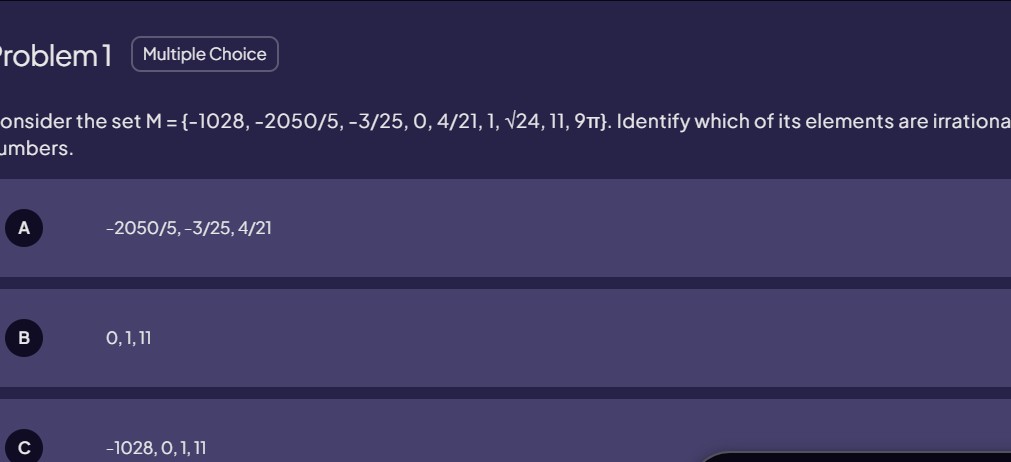
Final Answer: and are the irrational numbers in the set.
Explanation:
is irrational because 24 is not a perfect square.
is irrational because is irrational, and multiplying by 9 (a rational number) does not change that.
All other numbers in the set are either integers or fractions of integers, so they are rational.
Therefore, the correct answer is not listed among the options A, B, or C. The irrational numbers are and .
