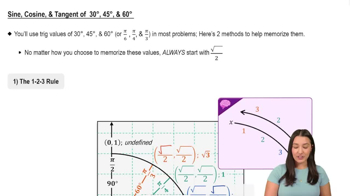
On the unit circle, what do the x and y coordinates of a point represent for a given angle?
The x coordinate represents the cosine of the angle, and the y coordinate represents the sine of the angle.
What is the '1, 2, 3 rule' used for in trigonometry?
It is a method for memorizing the sine and cosine values of 30°, 45°, and 60° by counting 1, 2, 3 clockwise for x (cosine) and counterclockwise for y (sine), then taking the square root over 2.
How do you simplify the cosine of 60 degrees using the '1, 2, 3 rule'?
Cosine of 60 degrees is the square root of 1 over 2, which simplifies to 1/2.
What is the sine of 30 degrees?
The sine of 30 degrees is 1/2.
How do you find the tangent of an angle using its sine and cosine values?
Tangent is found by dividing the sine value by the cosine value of the angle.
What is the tangent of 30 degrees, and how is it simplified?
The tangent of 30 degrees is 1/√3, which simplifies to √3/3 after rationalizing the denominator.
What does the 'left hand rule' help you memorize in trigonometry?
It helps you visually memorize the sine, cosine, and tangent values for common angles (30°, 45°, 60°) in the first quadrant.
In the left hand rule, which finger represents 30 degrees?
The finger closest to your pinky represents 30 degrees.
Using the left hand rule, how do you find the cosine of 30 degrees?
Count the number of fingers above the folded 30-degree finger (3), so cosine is √3/2.
Using the left hand rule, how do you find the sine of 30 degrees?
Count the number of fingers below the folded 30-degree finger (1), so sine is √1/2 or 1/2.
How do you use the left hand rule to find the tangent of 30 degrees?
Divide the square root of the number of fingers below by the square root of the number above (√1/√3), which simplifies to √3/3.
What do the x and y values on the unit circle also represent in a right triangle?
They represent the base (x) and height (y) of the corresponding triangle.
What is the general form for the sine and cosine values of 30°, 45°, and 60° using the '1, 2, 3 rule'?
They are all in the form of the square root of a number (1, 2, or 3) over 2.
How are the angles 0°, 30°, 45°, 60°, and 90° represented on your left hand in the left hand rule?
The pinky is 0°, the next three fingers are 30°, 45°, and 60°, and the thumb is 90°.
Why is it useful to practice finding trig values for angles in the first quadrant?
Practicing helps you quickly recall and understand the common sine, cosine, and tangent values for these angles.
 Back
Back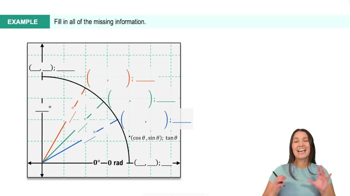
 6:04
6:04