Skip to main content
Precalculus
My Course
Learn
Exam Prep
AI Tutor
Study Guides
Flashcards
Explore
Try the app
My Course
Learn
Exam Prep
AI Tutor
Study Guides
Flashcards
Explore
Try the app
Back
Common Values of Sine, Cosine, & Tangent definitions
You can tap to flip the card.
Unit Circle
You can tap to flip the card.
👆
Unit Circle
A circle with radius 1 centered at the origin, used to relate angles to coordinates representing trigonometric values.
Track progress
Control buttons has been changed to "navigation" mode.
1/15
Related flashcards
Related practice
Recommended videos
Common Values of Sine, Cosine, & Tangent quiz
Common Values of Sine, Cosine, & Tangent
15 Terms
Common Values of Sine, Cosine, & Tangent
9. Unit Circle
3 problems
Topic
Reference Angles
9. Unit Circle
5 problems
Topic
9. Unit Circle
5 topics
10 problems
Chapter
6:04
Example 1
2
views
5:08
Sine, Cosine, & Tangent of 30°, 45°, & 60°
2
views
Terms in this set (15)
Hide definitions
Unit Circle
A circle with radius 1 centered at the origin, used to relate angles to coordinates representing trigonometric values.
First Quadrant
The section of the coordinate plane where both x and y values are positive, corresponding to angles from 0 to 90 degrees.
Cosine
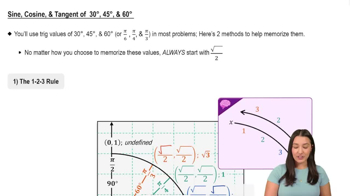
The x-coordinate of a point on the unit circle corresponding to a given angle, often found using the square root over 2 rule.
Sine
The y-coordinate of a point on the unit circle for a given angle, commonly determined by counting and using the square root over 2.
Tangent
A trigonometric value calculated by dividing sine by cosine for a given angle, often simplified using square roots.
Square Root Over 2 Rule
A method for finding sine and cosine values of common angles by placing the square root of a counted number over 2.
123 Rule
A memorization technique for trig values, involving counting 1, 2, 3 clockwise and counterclockwise to assign values to angles.
Left Hand Rule
A visual mnemonic using fingers to represent angles and count above or below a folded finger to find trig values.
Common Angles
Frequently used angles in trigonometry, specifically 30, 45, and 60 degrees, with easily memorized sine, cosine, and tangent values.
Denominator Rationalization
A process of removing square roots from the denominator of a fraction, often used in simplifying tangent values.
Base
The horizontal side of a right triangle in the unit circle, corresponding to the cosine value of an angle.
Height
The vertical side of a right triangle in the unit circle, corresponding to the sine value of an angle.
Numerator
The top part of a fraction, which in trigonometric ratios often involves a square root based on finger counting or angle position.
Denominator
The bottom part of a fraction, typically 2 in the square root over 2 rule for sine and cosine values.
First Quadrant Angles
Angles between 0 and 90 degrees, where all trigonometric values are positive and memorization techniques are commonly applied.
 BackBack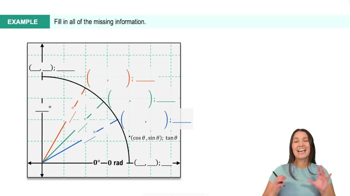
 6:04
6:04