The Circle: Videos & Practice Problems
The Circle is measured using the radius, diameter, circumference, and area. The radius is the distance from the center to the edge, and the diameter is the distance across the circle through the center. These are related by \(d=2r\) , so the diameter is twice the radius and the radius is half the diameter.
The distance around a circle is its circumference, not its perimeter. The key formulas are \(C=\pi d\) and \(C=2\pi r\) . The constant pi describes the relationship between circumference and diameter and is often approximated by 3.14 or \(\frac{22}{7}\).
The area inside a circle is found with \(A=\pi r^2\) . This formula comes from rearranging circle wedges into a shape like a parallelogram, where the base is \(\pi r\) and the height is \(r\). Area is written in square units.
Circumference of a Circle


What is the radius of the following circle?
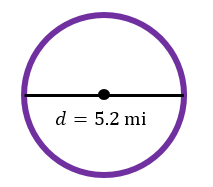
Find the circumference. Use .
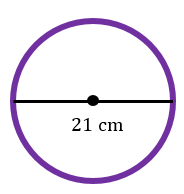
Find the circumference. Use .
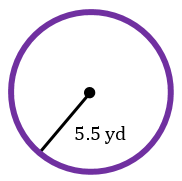
yd
yd
yd
yd
Circumference of a Circle Example 1
Area of a Circle
Find the area of the circle. Use and simplify.
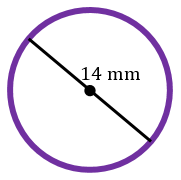
Find the area of the circle. Use and simplify.
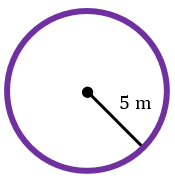
m2
m2
m2
m2
Area of a Circle Example 2
Here's what students ask on this topic:
The radius of a circle is the distance from its center to any point on the edge, while the diameter is the distance across the circle passing through the center. The diameter is always twice the length of the radius. This relationship can be expressed mathematically as , where is the diameter and is the radius. Conversely, the radius is half the diameter, so . Understanding this relationship is fundamental when calculating other properties of the circle, such as circumference and area.
The circumference of a circle is the distance around its edge. It is related to the diameter and radius through the constant pi (π), which is approximately 3.14 or . The formulas for circumference are or , where is the circumference, is the diameter, and is the radius. To find the circumference, multiply pi by the diameter or by twice the radius. This formula is essential for solving problems involving circular measurements.
Pi (π) is a special mathematical constant that represents the ratio of a circle's circumference to its diameter. This ratio is approximately 3.14159 and is an irrational number, meaning it has an infinite number of non-repeating decimal places. Pi is crucial because it allows us to relate linear measurements like diameter and radius to curved measurements like circumference and area. Without pi, we could not accurately calculate these properties. In formulas, pi is used as , and for practical calculations, it is often approximated as 3.14 or .
The area of a circle is the amount of space enclosed within its boundary. It is calculated using the formula , where is the area and is the radius. This formula comes from rearranging the circle into a shape similar to a parallelogram, where the base is and the height is . To find the area, square the radius and multiply by pi. The result is expressed in square units, such as square inches or square centimeters. This formula is fundamental in geometry and various applications involving circles.
Since pi (π) is an irrational number with infinite decimal places, it is often approximated for practical calculations. The two common approximations are the decimal 3.14 and the fraction . Using 3.14 is convenient for decimal-based calculations, while is useful for fraction-based problems. These approximations provide sufficient accuracy for most prealgebra and college-level problems involving circumference and area of circles. When higher precision is needed, more decimal places of pi can be used.
The units used for measuring the circumference of a circle are linear units, such as feet, inches, or centimeters, because circumference is a length around the circle. For example, if the radius is measured in feet, the circumference will also be in feet. On the other hand, the area of a circle is measured in square units, such as square feet (), square inches (), or square centimeters (), because area represents a two-dimensional space inside the circle. It is important to include the correct units when reporting your answers to avoid confusion.