
Ch 39: Particles Behaving as Waves
Young & Freedman Calc - University Physics 15th Edition
Young & Freedman Calc15th EditionUniversity PhysicsISBN: 9780135159552Not the one you use?Change textbook
Chapter 38, Problem 27a

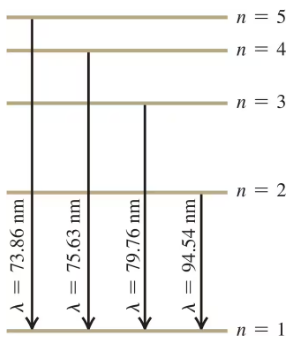
In a set of experiments on a hypothetical one-electron atom, you measure the wavelengths of the photons emitted from transitions ending in the ground level (n=1n = 1), as shown in the energy-level diagram in Fig. E39.2739.27. You also observe that it takes 17.5017.50 eV to ionize this atom. What is the energy of the atom in each of the levels (n=1n = 1, n=2n = 2, etc.) shown in the figure?
Energy-level diagram showing photon wavelengths for transitions in a one-electron atom, with levels labeled n=1 to n=5.

Verified step by step guidance
1
Step 1: Begin by recalling the relationship between the energy of a photon and its wavelength, given by the equation: E = hc/λ, where h is Planck's constant (6.626 × 10⁻³⁴ J·s), c is the speed of light (3.00 × 10⁸ m/s), and λ is the wavelength in meters.
Step 2: Convert the given wavelengths from nanometers to meters. For example, λ = 13.50 nm becomes λ = 13.50 × 10⁻⁹ m. Perform similar conversions for λ = 11.40 nm and λ = 10.81 nm.
Step 3: Calculate the energy of the photons corresponding to each wavelength using the formula E = hc/λ. This will give the energy difference between the levels involved in the transitions.
Step 4: Use the ionization energy of the atom, which is given as 17.50 eV, to determine the energy of the ground state (n = 1). The energy of the ground state is -17.50 eV, since ionization corresponds to the energy required to remove the electron from the ground state.
Step 5: Add the energy differences calculated in Step 3 to the ground state energy to determine the energy of the higher levels (n = 2, n = 3, and n = 4). For example, the energy of n = 2 is E2 = E1 + ΔE, where ΔE is the energy difference corresponding to the transition from n = 2 to n = 1.

Verified video answer for a similar problem:

This video solution was recommended by our tutors as helpful for the problem above.
Video duration:
7m
Was this helpful?

Key Concepts

Here are the essential concepts you must grasp in order to answer the question correctly.

Energy Levels in Atoms

In quantum mechanics, electrons in an atom occupy discrete energy levels, denoted by quantum numbers (n). The ground state corresponds to n=1, while higher levels (n=2, n=3, etc.) represent excited states. The energy of an electron in a level is quantized, meaning it can only take specific values, which are determined by the potential energy of the electron in the electric field of the nucleus.
Recommended video:
Guided course
01:06
Charge of Atom

Photon Emission and Wavelength

When an electron transitions from a higher energy level to a lower one, it emits a photon whose energy corresponds to the difference between the two levels. The energy of the emitted photon can be calculated using the equation E = hc/λ, where E is the energy, h is Planck's constant, c is the speed of light, and λ is the wavelength. This relationship allows us to determine the energy levels based on the measured wavelengths of emitted photons.
Recommended video:
Guided course
05:42
Unknown Wavelength of Laser through Double Slit

Ionization Energy

Ionization energy is the amount of energy required to remove an electron from an atom in its ground state. For the hypothetical one-electron atom in the question, the ionization energy is given as 17.50 eV. This value indicates the energy needed to completely free the electron from the influence of the nucleus, and it also helps in calculating the energy levels of the atom, as the energy of the ground state is typically negative and the ionization energy represents the transition to zero energy.
Recommended video:
Guided course
04:10
Intro to Energy & Types of Energy
Related Practice
Textbook Question

The energy-level scheme for the hypothetical one-electron element Searsium is shown in Fig. E39.25E39.25. The potential energy is taken to be zero for an electron at an infinite distance from the nucleus. An 1818-eV photon is absorbed by a Searsium atom in its ground level. As the atom returns to its ground level, what possible energies can the emitted photons have? Assume that there can be transitions between all pairs of levels.

Textbook Question

A triply ionized beryllium ion, Be3+ (a beryllium atom with three electrons removed), behaves very much like a hydrogen atom except that the nuclear charge is four times as great. What is the ground-level energy of Be3+? How does this compare to the ground-level energy of the hydrogen atom?

2
views
Textbook Question

Use Balmer's formula to calculate (a) the wavelength, (b) the frequency, and (c) the photon energy for the Hg line of the Balmer series for hydrogen.

Textbook Question

A triply ionized beryllium ion, Be3+ (a beryllium atom with three electrons removed), behaves very much like a hydrogen atom except that the nuclear charge is four times as great. For the hydrogen atom, the wavelength of the photon emitted in the n=2n = 2 to n=1n = 1 transition is 122122 nm (see Example 39.639.6). What is the wavelength of the photon emitted when a Be3+ ion undergoes this transition?

Textbook Question

Using a mixture of CO2, N2, and sometimes He, CO2 lasers emit a wavelength of 10.610.6 μ\(\mu\)m. At power of 0.1000.100 kW, such lasers are used for surgery. How many photons per second does a CO2 laser deliver to the tissue during its use in an operation?

Textbook Question

Find the longest and shortest wavelengths in the Lyman and Paschen series for hydrogen. In what region of the electromagnetic spectrum does each series lie?